
- What Makes a Shoppable Video Example Worth Studying
- 1. Dame — $26,000 More Per Month
- 2. ThruDark — $5,854 in 30 Days
- 3. LNDR — The 3-Video Rule
- 4. Transformer Table — 400+ Customer Homes
- 5. Vibe Kayaks — 80+ Brand Ambassadors
- 6. American Candy Store — Self-Updating Content Library
- 7. Mockingbird — Parents Helping Parents
- 8. Oru Kayak — Word-of-Mouth Trust Online
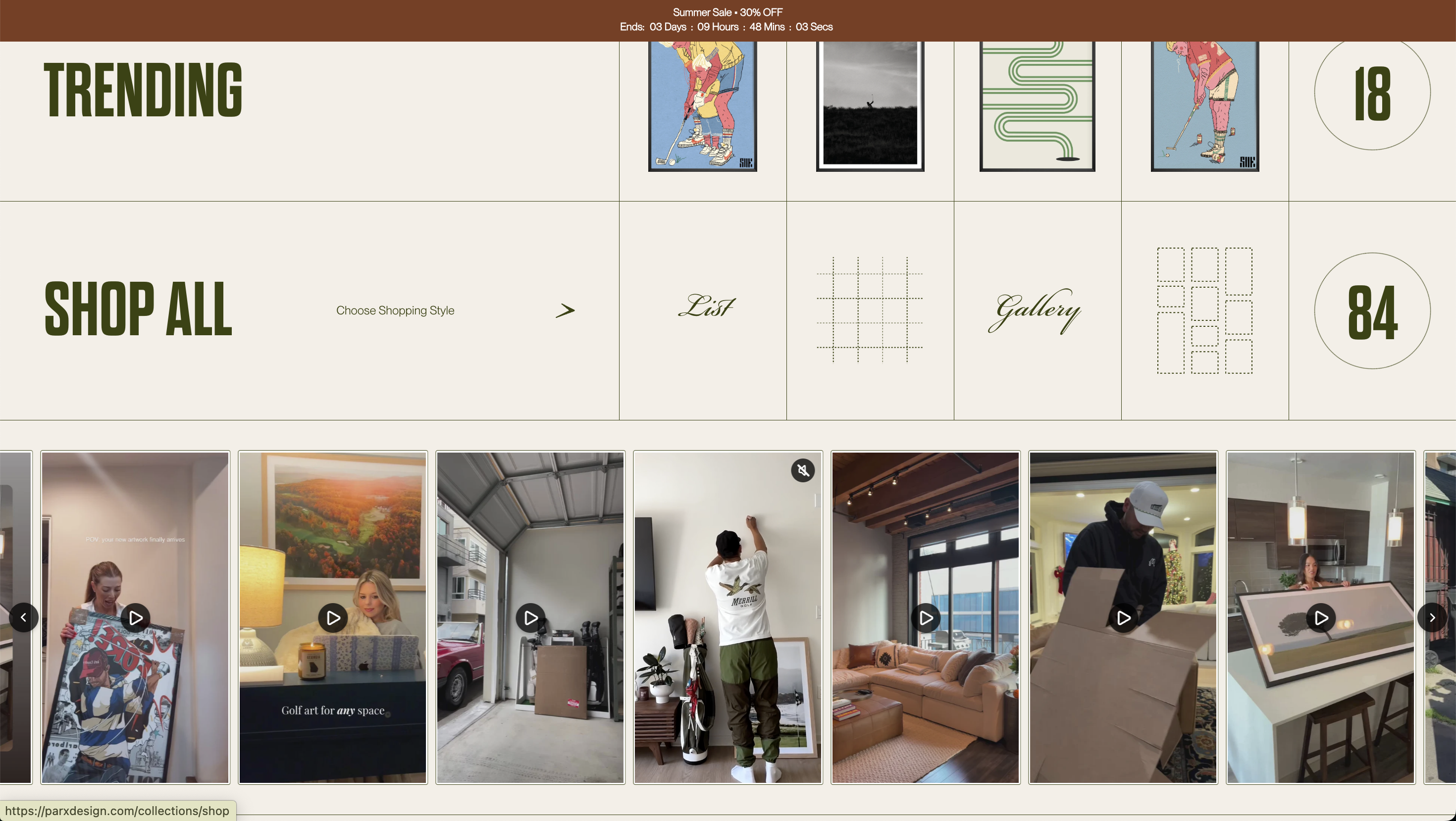
- 9. Par x Design — UGC Plus Star Ratings
- 10. Fellow — Interactive Product Tour
- What These 10 Examples Have in Common
- Frequently Asked Questions
Real stores, real results, real strategies you can steal. Here's exactly how ten Shopify brands are using shoppable video — and what's working.
What Makes a Shoppable Video Example Worth Studying
There are plenty of brands experimenting with video on their Shopify stores. Fewer are doing it in a way that actually moves revenue. The ten examples in this post were chosen because each one demonstrates a distinct, replicable strategy — not just "we added video and things got better," but a specific approach that other merchants can look at, understand, and apply to their own store.
Some of these brands used shoppable video to directly lift conversion rates. Others built communities of brand ambassadors. Others replaced support tickets with interactive tutorials. None of them required a production budget, a developer, or a wholesale change to their store. What they all did was find the right format, put video in the right place, and make the content work harder than it was working sitting on social media.
1. Dame — $26,000 More Per Month From Existing Social Content
Category: Beauty / Wellness | Strategy: Import social video to PDPs, no new content created
Dame had a strong social presence — plenty of video content across Instagram and TikTok that was already performing well. The problem was that content stayed on social. Shoppers who saw it, got curious, navigated to the website, and landed on a product page with static images. The thing that had convinced them to look in the first place had disappeared.
They used Moast to import their existing social video directly onto their product pages as shoppable carousels. No new shoots, no production budget, no developer. The content was already there — it just needed to be in the right place.
Results: $26,000 increase in monthly revenue, 17% lift in conversion rate, $0.16 improvement in revenue per visitor — without increasing traffic.
What to steal: Before creating any new video, audit what already exists on your brand's social channels. Most merchants have more usable content than they realize — and moving it to product pages is faster than anything else you could do.
2. ThruDark — $5,854 in 30 Days Above the Reviews Section
Category: Performance Apparel | Strategy: UGC carousel placed directly above the reviews section
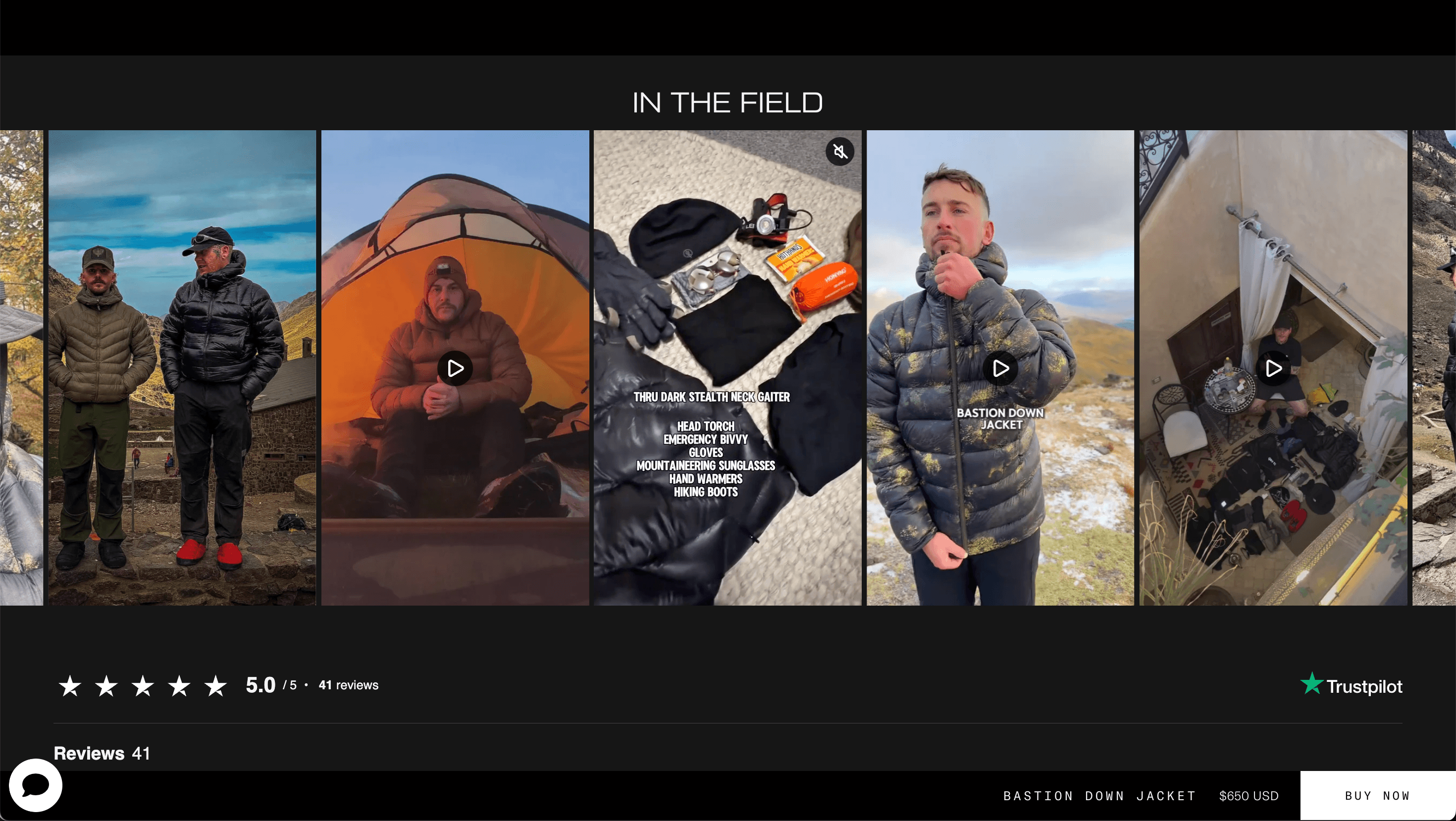
ThruDark makes premium performance apparel for people who demand a lot from their gear — founded by former special forces operators, their products are technical, premium-priced, and highly visual. Customers need to see garments in real, demanding conditions to feel confident buying.
The placement decision is what makes this example stand out. ThruDark didn't just add a video widget — they placed it directly above their reviews section on every PDP. That's the exact moment a shopper looks for social proof before buying, and the exact moment that a real customer in a real environment is the most persuasive thing possible.
They used content they already had — UGC and social footage that had been sitting in their feed — and applied it to the highest-leverage position on their product pages.
Results: 293 videos live across PDPs, 3,390+ monthly video views, $5,854 in directly attributable sales in the first 30 days.
What to steal: If you take one placement insight from this post, make it this one. Above the reviews section is the highest-converting position on a product page for shoppable video — it consistently outperforms above-the-fold, below-description, and bottom-of-page placements.
3. LNDR — The 3-Video Rule That Drives 100,000+ Monthly Views
Category: Activewear | Strategy: Three specific video types per PDP, powered by custom feeds
LNDR is a premium activewear brand making high-performance pieces designed to move with the wearer. Their challenge: showing how technical fabric actually behaves in use — how it stretches, drapes, and performs — through a format that a static image simply cannot capture.
Their approach was both systematic and scalable. Rather than picking random videos for each product page, LNDR developed a three-video rule: every PDP shows the product in exactly three ways — a customer UGC clip, a testimonial video, and the product in action. Each type of video answers a different question the shopper has: what does it look like on a real person? Does it actually work? How does it move?
Using Moast's custom feeds, this setup runs automatically across their entire store. Add a new product, and the right three video types are already mapped to it. No manual management for the team.
Results: 393 videos across product pages, 100,000+ video views in the first few weeks, 50+ direct sales attributed to video.
What to steal: Think about the three questions shoppers are asking when they land on your product page. Then build one video type per question. The 3-video rule is simple enough to execute at scale but specific enough to be genuinely useful to the shopper.
4. Transformer Table — 400+ Customer Homes as Live Showrooms
Category: Home Furniture | Strategy: Ambassador program turning customer homes into a distributed showroom
Transformer Table makes multifunctional dining furniture generating over $100M in annual sales — but with only a virtual showroom, customers struggled to visualize how the unique folding tables would look and work in a real home. Photos of the table in a perfectly styled studio setting didn't answer the question shoppers were actually asking: "will this fit in my house?"
Their solution was to turn the homes of real customers into the showroom. They reached out to their most engaged existing customers with an ambassador invitation, offering rewards for creating and sharing content of the table in their home. Through Moast, all that content was collected, displayed on an interactive map, and made available to new shoppers — who could browse real homes, ask questions, and even arrange meetups with owners near them.
Results: 400+ customers onboarded as home showroom ambassadors, 1,000+ pieces of customer content collected, 250+ shopper-to-customer interactions and meetups.
What to steal: For any product that shoppers need to "see in context" before buying — furniture, decor, outdoor equipment, large appliances — consider whether your best customers are already a distributed showroom you haven't activated yet.
5. Vibe Kayaks — A Community of 80+ Brand Ambassadors
Category: Outdoor Sports | Strategy: Community content collection with discount incentives
Vibe Kayaks makes adventure-ready kayaks for outdoor enthusiasts — accessible, well-designed, and the kind of product people are genuinely excited to share photos and videos of on the water. The brand knew their community was passionate. The question was how to channel that into content that would actually convert new shoppers.
They used Moast Collect to set up a submission page where customers could share their adventures directly. To encourage submissions, they offered discounts in exchange for video content. The result: a growing library of authentic on-the-water content that updates itself as customers keep submitting.
Results: 80+ community members actively sharing their adventures, 230+ pieces of customer content collected, 10,000+ content views per month.
What to steal: A modest discount incentive (10–15% off a future order) in exchange for a video submission consistently drives high submission rates — particularly in categories where customers are already creating content about the product.
6. American Candy Store — A Self-Updating Creator Content Library
Category: Specialty Food | Strategy: Import creator TikToks by URL, set up a Collect landing page for ongoing submissions
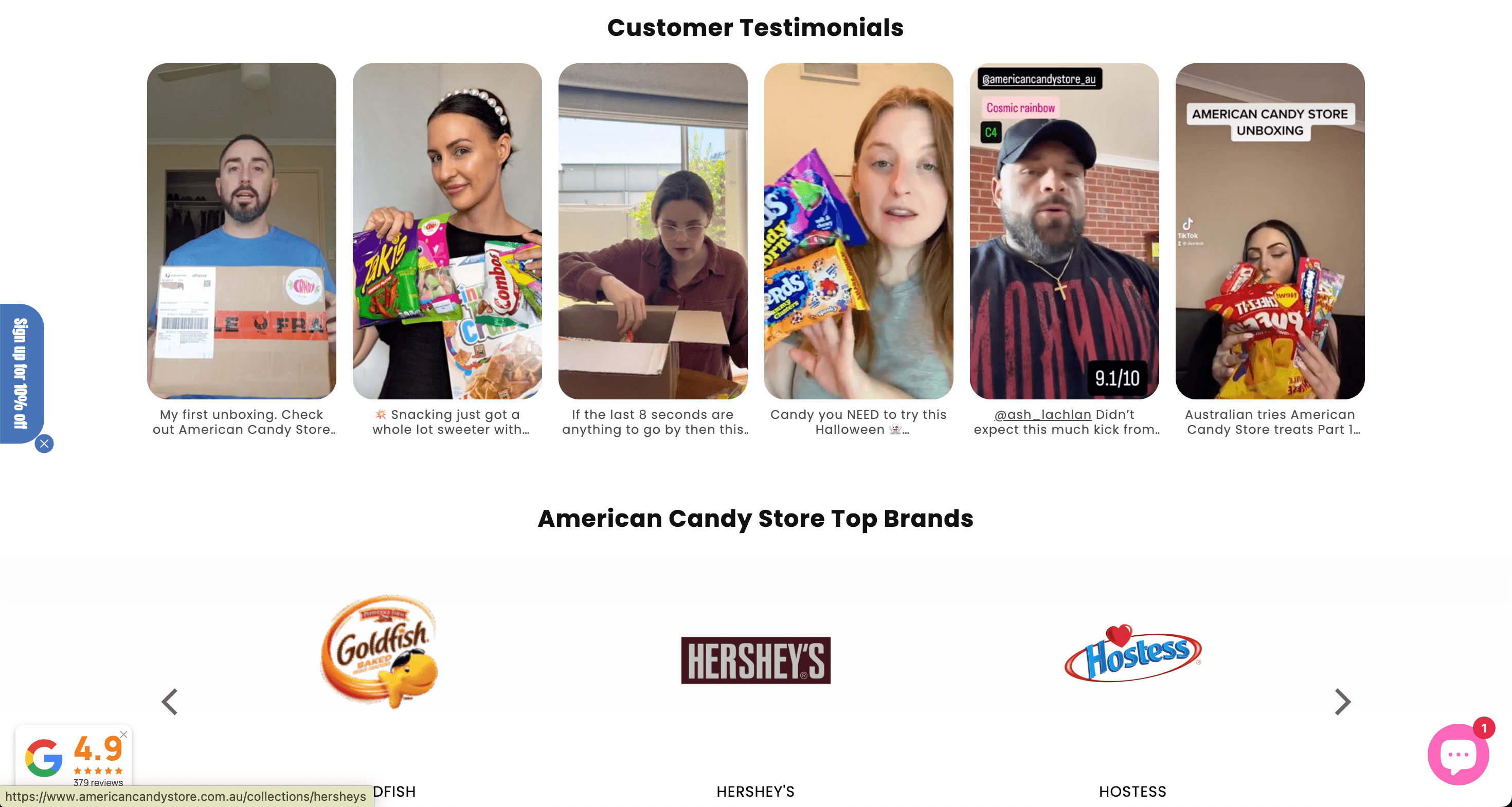
American Candy Store sells U.S. sweets and snacks in Australia — a novelty product where the taste reaction and first-impression moment is the entire selling experience. Their best content was already being created for them by influencers and customers on TikTok and Instagram. The challenge was getting that content working on the store rather than just on social.
They imported creator TikTok content directly onto their homepage and product pages by pasting URLs into Moast — no downloading, no re-uploading. They also set up a dedicated Moast Collect landing page where customers could submit their own unboxing and reaction videos. New submissions auto-feed into the widgets. Every video displays creator credits and links back to the creator's social profile — giving creators an incentive to keep producing content and giving shoppers an additional trust signal.
What to steal: If creators are already making content featuring your products, import by profile mention to find it all in one pass. Then set up Social Sync to catch everything going forward automatically.
7. Mockingbird — Parents Helping Parents Buy With Confidence
Category: Baby Products | Strategy: Community ambassador program, peer-to-peer trust model
Mockingbird makes beautifully designed strollers at accessible prices — a high-consideration category where new parents are understandably anxious, careful, and deeply skeptical of brand marketing. The insight that drove their shoppable video strategy was simple: new parents trust other parents far more than they trust a brand.
Rather than trying to convince shoppers through polished brand content, Mockingbird built a platform for their existing customers to do the convincing instead. They invited 140+ parents to become brand ambassadors through Moast, giving them a space to share their experiences and connect directly with prospective buyers who had questions about the stroller.
Results: 140+ parent ambassadors, 90+ shopper-to-customer interactions facilitated, 500+ pieces of customer content collected.
What to steal: In high-consideration categories where trust is the primary barrier — baby products, medical devices, premium electronics, high-ticket furniture — peer-to-peer social proof is often more powerful than any video you could produce yourself.
8. Oru Kayak — Recreating Word-of-Mouth Trust Online
Category: Outdoor Equipment | Strategy: Interactive explorer program with map-based community discovery
Oru Kayak makes foldable, origami-inspired kayaks that go anywhere. Their best organic marketing had always happened in person — one person sees someone paddling an Oru kayak, gets curious, asks about it, and buys one. The problem was that this word-of-mouth dynamic is impossible to replicate online through a standard product page.
Their solution was to build that conversation into the buying experience. They launched the Oru Explorer Program through Moast, inviting customers to create profiles, share their adventure content, and appear on an interactive map. Prospective buyers could browse Oru owners near them, reach out with questions, watch video content from real kayaking trips, and even arrange meetups on the water.
Results: 270+ active community members, 530+ shopper-to-customer connections, 3.85 average connections per week.
What to steal: If your product is one that people naturally talk about after buying — outdoor gear, adventure equipment, fitness products — think about how you can structure that word-of-mouth as part of the buying experience rather than leaving it to chance.
9. Par x Design — UGC Plus Star Ratings in One Clean Widget
Category: Golf Apparel / Design | Strategy: Moast + Junip integration, showing star ratings directly alongside video
Par x Design is a modern golf-inspired art brand known for bold, limited-run designs. Their products are visually striking and design-forward — exactly the kind of thing that looks better on a real person than on a hanger. Their product pages needed to show how pieces looked and felt in the real world, not just in a studio.
They used Moast to bring short-form customer and creator videos onto their product pages with full widget customization to match their sleek, minimal aesthetic. The detail that makes their implementation stand out is the Junip integration: Par x Design activated Moast's integration with Junip to automatically display customer star ratings directly alongside each video.
The result is a single widget that combines UGC video with verified review ratings — two trust signals working in tandem. Shoppers watch a customer wearing a hat or hoodie and immediately see its Junip star rating, without scrolling or clicking anywhere else.
Results: 30,000+ video views in the first month.
What to steal: If you're already using a review app like Junip, Yotpo, or Judge.me, look at whether your video app integrates with it. Combining authentic video with star ratings in one placement gives shoppers two trust signals at once and removes a step from the social proof journey.
10. Fellow — Replacing Static Manuals With an Interactive Product Tour
Category: Coffee Equipment / Electronics | Strategy: Step-by-step carousel widget as a visual setup guide
Fellow makes premium coffee gear — grinders, pour-over kettles, espresso machines — designed with precision and an exceptional attention to detail. Buying a premium espresso machine is exciting. Setting it up can be overwhelming. Long PDF manuals don't match the premium experience Fellow has built into the physical product.
Instead of asking customers to read a manual, Fellow built a step-by-step interactive setup experience using Moast's carousel widget. Customers follow visual, bite-sized video steps instead of dense text. The experience lives on a dedicated learning page — accessible to shoppers researching pre-purchase and to customers needing setup support post-purchase.
Results: Static manuals replaced with an interactive visual experience. Reduced post-purchase confusion and support needs.
What to steal: Shoppable video doesn't have to be social proof or UGC. For technical, complex, or premium products, a step-by-step setup guide built in a video carousel is one of the highest-ROI things you can build — it reduces support tickets, improves the customer experience, and gives pre-purchase shoppers confidence that setup won't be a nightmare.
What These 10 Examples Have in Common
Looking across all ten brands, a few patterns emerge consistently:
- The content already existed. Dame, ThruDark, LNDR, American Candy Store — none of them created new video for their shoppable strategy. They moved existing social content, existing UGC, existing customer stories to a place where it could actually drive purchases.
- Placement was a deliberate decision. ThruDark's results came specifically from placing video above the reviews section — not just anywhere on the page. Every brand that saw strong results made a conscious choice about where the video would live and why that position made sense for their specific customer journey.
- Authenticity outperformed production value. Not one of these examples is built on high-budget brand video. The content that converts is real customers in real conditions — which is also the cheapest and most scalable content to produce.
- The best implementations have a system. LNDR has the three-video rule. American Candy Store has Social Sync. Transformer Table has an ambassador program. Vibe Kayaks has Moast Collect with a discount incentive. Each brand built a mechanism to keep content flowing rather than treating it as a one-time project.
Whether you're a fitness brand, a furniture maker, a specialty food retailer, or a premium equipment brand, the strategic principles are consistent. The content you already have is more valuable than you think. It just needs to be in the right place, with a product tag that makes buying immediate.
Get started with Moast for free
Related reading: How to use UGC video to boost Shopify sales · How to add shoppable video to your Shopify store · Does shoppable video actually increase conversions?
Frequently Asked Questions
What is a shoppable video example?
A shoppable video is any video on a website that includes embedded product tags — small interactive elements that let viewers tap or click to view a product page or add to cart directly from within the video. The examples in this post all use Moast to display shoppable video on their Shopify stores, with product tags embedded in customer-generated or social content.
What types of shoppable video work best on Shopify?
The highest-converting types are authentic UGC and customer testimonials placed above the reviews section on product pages. Beyond that, the best format depends on the category: try-on and fit content for apparel, taste reactions for food, durability demonstrations for equipment, and step-by-step tutorials for technical products.
How do Shopify brands collect video for shoppable content?
Most brands use a combination of three sources: importing existing TikTok and Instagram content by URL, collecting customer-submitted videos through a tool like Moast Collect, and using Social Sync to automatically pull in new social content every 24 hours. Many of the brands in this post started with content they already had on social and added a collection system afterward.
How long does it take to see results from shoppable video?
ThruDark saw $5,854 in attributable sales within the first 30 days. Par x Design hit 30,000 video views in their first month. Dame's revenue lift was visible within their first billing period. Most merchants start seeing measurable impact within 2–4 weeks of going live on their top product pages.
Do you need a big video production budget for shoppable video?
No — and the brands with the best results here deliberately didn't use one. Dame, ThruDark, and LNDR all started with existing social content. American Candy Store used creator TikToks. Mockingbird and Transformer Table used content from their existing customers. The most effective shoppable video content is authentic and low-production — which also makes it the most accessible for brands of any size.
October 12, 2026
Related content
.jpg)
.jpg)
.jpg)
Turn your social content into a revenue channel
Turn your TikToks and Reels into shoppable videos and boost conversions by 3.5x.