


- What Is UGC Video and Why It Matters for Shopify Stores Today
- UGC Video vs Influencer Content vs Brand Content
- Why Most Shopify Brands Struggle With UGC Video Sourcing
- The Best Types of Creators for UGC Videos on Shopify
- Sourcing UGC Video From Existing Customers
- Using Moast Collect to Source Video Content at Scale
- When to Use Paid UGC Creators for Your Shopify Store
- How to Run UGC Video Campaigns Without Burning Time or Budget
- Launching Creator Campaigns Through Moast’s UGC Projects Program
- Where UGC Videos Perform Best on Shopify Stores
- How UGC Video Impacts Conversion Rate, Time on Site, and Revenue
- Repurposing UGC Videos Across Ads, Email, and Social Channels
- Legal, Rights, and Usage Considerations for UGC Video
- Building a Scalable, Always-On UGC Video Engine
- Final Takeaways on Sourcing UGC Video Creators for Shopify
User-generated video content has quietly become one of the most reliable conversion drivers in ecommerce. Not because it is flashy or perfectly produced, but because it mirrors how people actually make buying decisions. Shoppers want proof. They want context. They want to see real people using real products before committing their money.
For Shopify brands, the challenge is no longer whether UGC video works. It is how to source it consistently, without burning time, budget, or team bandwidth.
This guide breaks down how Shopify stores can source high-quality UGC video from creators and customers, how to operationalize it, and how to build a repeatable system instead of relying on one-off campaigns.
What Is UGC Video and Why It Matters for Shopify Stores Today
UGC video refers to short-form video content created by customers or creators that showcases a product in a real-world setting. This can include unboxings, tutorials, reactions, lifestyle usage, before-and-after demos, or simple testimonials filmed on a phone.
What makes UGC video different from traditional brand video is intent. UGC is not designed to impress. It is designed to reassure.
Modern Shopify shoppers behave differently than they did even a few years ago. They scroll product pages looking for social proof. They pause on videos that feel unpolished but honest. They trust content that looks like it came from someone like them.
This is why UGC video consistently outperforms static reviews and studio-produced assets on product detail pages. It answers questions that written copy cannot. It shows scale, texture, usage, and outcomes. It reduces uncertainty.
Several studies support this shift. Research from PowerReviews shows that shoppers who interact with UGC convert at significantly higher rates than those who do not. TikTok and Meta have also repeatedly shared that creator-style videos outperform polished ads in both engagement and ROAS.
On Shopify specifically, UGC video plays an outsized role because many stores sell products that benefit from demonstration. Apparel, beauty, wellness, furniture, fitness, electronics, and food brands all rely heavily on visual context to drive confidence.
The result is simple. If your Shopify store does not feature UGC video, shoppers are likely getting that validation elsewhere, usually on social platforms, before returning to purchase.
UGC Video vs Influencer Content vs Brand Content
Not all video content serves the same purpose, even if it looks similar on the surface. Understanding the differences between UGC video, influencer content, and brand content helps clarify why sourcing strategies matter.
EMBED YOUTUBE VIDEO: https://www.youtube.com/watch?v=aVGqc47csMw
Brand content is created by the company. It is controlled, polished, and consistent. It works well for explaining positioning, features, and high-level messaging. It rarely builds immediate trust on its own.
Influencer content is created by individuals with an existing audience. It is effective for reach and awareness, especially when discovery is the goal. The downside is cost, limited usage rights, and inconsistent performance once placed on a product page.
UGC video sits between the two. It does not rely on audience size. It does not need perfect lighting. Its strength comes from relatability. A shopper does not care how many followers the person has. They care whether the product works for someone like them.
This is why UGC video tends to perform best on Shopify product pages, landing pages, and lower-funnel ads. It answers objections instead of broadcasting messages.
Many high-performing brands now use influencer partnerships primarily to source UGC that can be repurposed across owned channels, rather than relying on influencer reach alone.
Why Most Shopify Brands Struggle With UGC Video Sourcing
Despite knowing the value of UGC video, most Shopify brands struggle to build a consistent pipeline. The reasons are rarely strategic. They are operational.
The most common mistake is relying entirely on cold outreach. Brands DM creators, send emails, negotiate rates, manage briefs, chase revisions, and track deliverables manually. This approach works for a handful of videos but breaks down quickly.
Another issue is quality control. Without a system, brands receive videos that look nice but do not answer key buyer questions. Others receive content that cannot be used on product pages due to rights issues or missing permissions.
Some brands over-index on paid creators and overlook their existing customers. Others collect customer videos informally but have no way to organize, display, or reuse them effectively.
The core problem is not a lack of creators. It is the absence of infrastructure.
UGC sourcing works best when it is treated like a system, not a campaign.
The Best Types of Creators for UGC Videos on Shopify
Not all creators drive the same outcome. The biggest mistake Shopify brands make with UGC is assuming that any creator can produce content that converts. In reality, different creator types excel at different jobs across the funnel.
Instead of thinking in terms of follower count, it’s more useful to think in terms of use case.
Below is a practical breakdown of creator types, when to use them, and where they perform best on a Shopify store.
Existing Customers (High Trust, Low Friction)
If you had to choose only one creator group to invest in long-term, it should be your customers.
Customer-generated videos carry a level of credibility that no paid content can replicate. These creators are not trying to perform. They are sharing lived experience. Their language is natural, their environment is real, and their motivations feel honest.
Best for:
- Product detail pages
- High-consideration products
- Reducing buyer hesitation
Strengths:
- Extremely high trust
- Low cost to source
- Strong alignment with real buyer objections
Limitations:
- Less predictable structure
- Requires guidance to improve consistency
Customer creators work especially well when paired with light prompts or frameworks. A simple request like “show how you use it” or “what problem did this solve for you” produces far better results than an open-ended ask.
This is also where tools like Moast’s Collect widget become valuable, since they guide customers through submission while capturing usable permissions.
Micro-Creators (Flexible and Repeatable)
Micro-creators are individuals who may not have a meaningful audience but understand how to create content that looks good on camera.
Many of these creators specialize in UGC production rather than influencing. They know how to frame shots, speak clearly, and follow briefs. Their value is not reach. It is execution.
Best for:
- Filling content gaps quickly
- Producing multiple variations
- Testing different hooks and angles
Strengths:
- Affordable compared to influencers
- Consistent quality
- Easy to brief and iterate with
Limitations:
- Less organic than customer content
- Requires clear direction to avoid generic videos
Micro-creators are ideal when you need volume. For example, launching a new product often requires multiple videos that explain features, usage, and benefits from different perspectives.
Niche Experts (Authority and Education)
Some products need more than enthusiasm. They need explanation.
Niche experts bring authority that accelerates trust, especially for technical, premium, or unfamiliar products. Think fitness trainers explaining equipment, chefs demonstrating cookware, or stylists breaking down apparel fit.
Best for:
- Technical or high-ticket products
- Education-focused PDPs
- Reducing pre-purchase questions
Strengths:
- High perceived expertise
- Strong clarity for shoppers
- Ideal for longer-form video UGC
Limitations:
- Higher sourcing effort
- Often higher cost per video
Expert creators are especially effective when your support team answers the same questions repeatedly. One clear, expert-led video can reduce friction across sales and support at the same time.
Lifestyle Creators (Context and Aspiration)
Lifestyle creators show products in use rather than explaining them directly. Their value comes from context. How the product fits into daily life. How it looks in a real setting. How it complements a routine.
Best for:
- Homepage and collection pages
- Visual-first brands
- Emotional buying decisions
Strengths:
- Strong visual appeal
- Helps shoppers imagine ownership
- Easy to repurpose for ads
Limitations:
- Less feature-focused
- May not answer practical objections alone
Lifestyle UGC works best when paired with customer or expert content. One shows the feeling. The other confirms the decision.
Repeat Creators (The Most Underrated Category)
One of the highest-leverage moves Shopify brands can make is identifying creators who perform well and working with them repeatedly.
Repeat creators learn your product, your messaging, and your expectations. Each video improves. Feedback loops get tighter. Production speeds up.
Best for:
- Long-term UGC strategies
- Always-on content engines
- Reducing onboarding overhead
Why this matters:
Consistency matters more than novelty when building a content library that converts. A small roster of reliable creators often outperforms a large, constantly rotating pool.
This is also why many brands move from one-off outreach to managed affiliate programs or platforms that help coordinate creator relationships over time.
How to Choose the Right Creator Mix
Instead of asking “which creator type is best,” a better question is:
What question does the shopper need answered at this point in the journey?
- Trust → customers
- Clarity → experts
- Volume → micro-creators
- Context → lifestyle creators
The strongest Shopify stores combine these inputs into a balanced UGC system rather than relying on a single source.
If you want, next I can:
- Rewrite another section using a different layout
- Convert this into a table-based comparison
- Align this section more tightly with Moast’s Collect and UGC Projects workflows
Sourcing UGC Video From Existing Customers
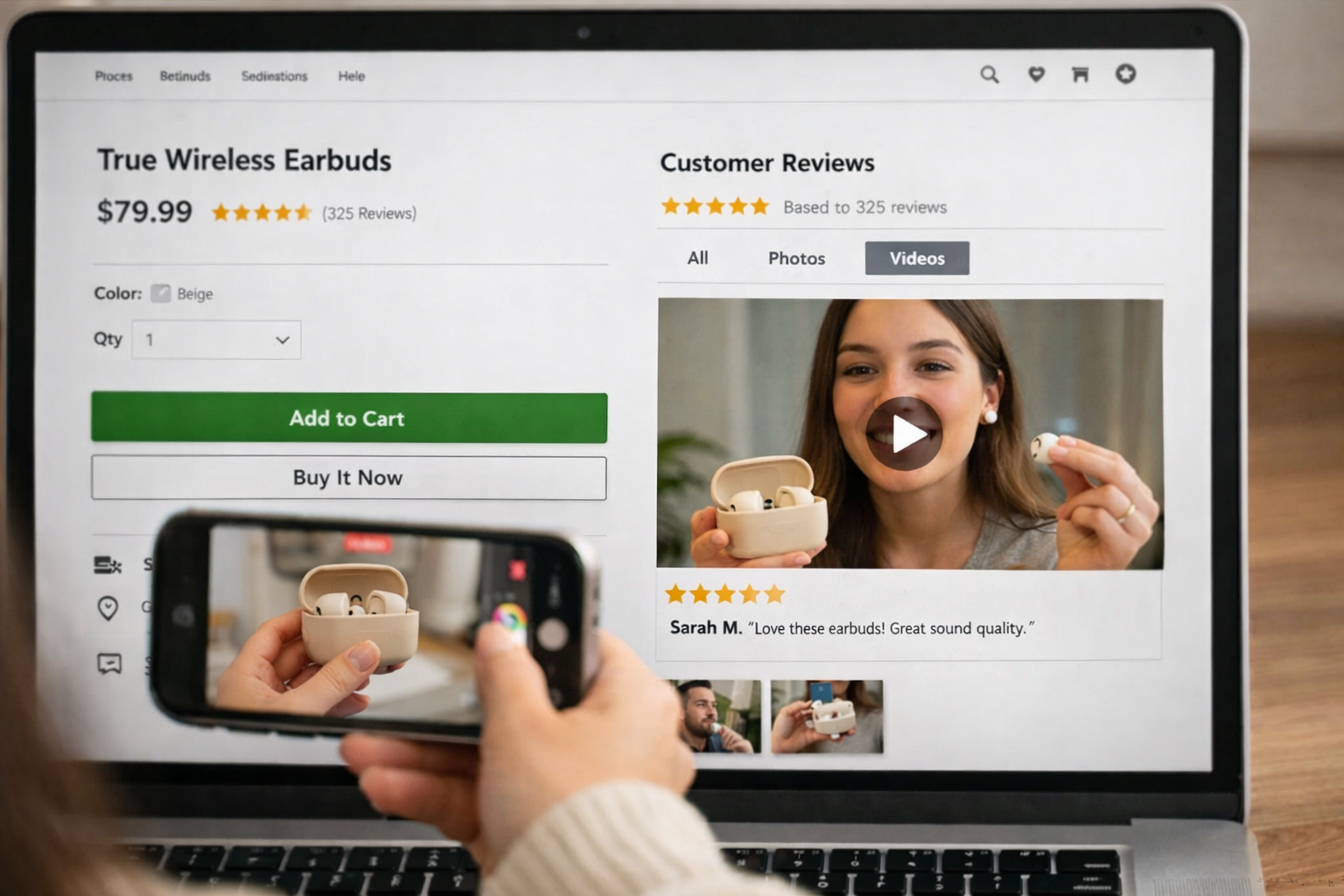
Customer-generated video is one of the most underutilized assets in ecommerce. The people already buying from you are often your best creators.
Customers bring authenticity that paid creators cannot fake. They use the product in real environments. They speak naturally about outcomes. They highlight benefits that brands would never think to script.
The challenge is asking at the right moment.
Effective customer UGC sourcing happens post-purchase, when excitement is still high but experience has formed. Email, SMS, and in-store prompts work well when framed as participation rather than promotion.
Incentives help, but they do not need to be large. Discounts, store credit, early access, or simple recognition are often enough.
What matters most is clarity. Customers need to know what to film, how long it should be, and where to upload it. Without guidance, submission rates drop and quality varies.
This is where tooling becomes critical.
Using Moast Collect to Source Video Content at Scale
Moast offers a Collect widget designed specifically to help Shopify brands gather UGC video directly from customers without manual follow-ups.
Instead of chasing content, brands can place a submission experience directly on their site or trigger it after purchase. Customers upload videos through a simple flow, with permissions handled upfront.
The advantage of this approach is compounding value. One prompt can generate dozens or hundreds of videos over time. Content becomes an always-on asset rather than a one-off effort.
Moast’s Collect flow works particularly well for brands with repeat customers, subscription products, or high engagement communities. It turns customer enthusiasm into usable video content that can be displayed immediately on product pages.
Because the videos live inside shoppable widgets, the content does not just exist. It actively drives conversion by letting shoppers watch and buy in the same moment.
For brands already investing in retention and community, customer-sourced UGC is often the fastest win.
When to Use Paid UGC Creators for Your Shopify Store
Paid UGC creators make sense when your content needs to be intentional, repeatable, and fast.
Use paid UGC creators when:
- You are launching a new product and have no customer content yet
- Your product pages need clear demos, comparisons, or walkthroughs
- Ad performance is declining and you need fresh creative angles
- You want multiple variations of the same message for testing
Why paid creators work well in these cases:
- They follow briefs and deliver structured videos
- Turnaround times are predictable
- Content is easier to reuse across ads, PDPs, and email
Where they fit in your overall UGC strategy:
- Paid creators fill short-term gaps
- Customer videos build long-term trust
- Together, they create a balanced UGC library
Paid UGC should not replace customer-generated content. It works best as a supporting layer that helps Shopify brands move faster while keeping authenticity at the core.
How to Run UGC Video Campaigns Without Burning Time or Budget
The biggest hidden cost in UGC sourcing is management. Emails, feedback, revisions, approvals, and storage add up quickly.
Brands that scale UGC successfully rely on repeatable processes. Standard briefs. Defined video lengths. Clear examples of what good looks like.
Approval cycles should be fast. If a video answers buyer questions and feels authentic, perfection is unnecessary.
Storage and organization also matter. Videos need to be tagged, searchable, and easy to deploy across channels.
Without systems, teams burn out. With systems, UGC becomes one of the highest ROI content investments available.
Launching Creator Campaigns Through Moast’s UGC Projects Program
For brands that want high-quality UGC without managing creators directly, Moast also offers a UGC Projects program.
This program helps Shopify merchants launch targeted creator campaigns to fill specific content gaps. Whether the goal is product education, seasonal content, or ad-ready videos, the process is guided and structured.
The advantage is speed and quality control. Brands avoid the overhead of sourcing, vetting, and briefing creators individually. The output is content designed specifically for conversion use cases.
This approach works especially well for brands scaling quickly or teams without dedicated content managers.
More details here: https://www.moast.io/ugc-for-shopify
Where UGC Videos Perform Best on Shopify Stores
%20(1).png)
UGC video placement matters as much as the content itself.
Product pages are the highest-impact location. Videos placed near product images or above the fold help answer questions before doubt sets in.
Homepages and collection pages benefit from lifestyle-oriented UGC that communicates brand feel quickly.
UGC also performs well in post-purchase flows, onboarding sequences, and support content, where it reinforces confidence and reduces returns.
The most effective Shopify stores treat UGC as core merchandising, not decoration.
How UGC Video Impacts Conversion Rate, Time on Site, and Revenue
UGC video consistently improves engagement metrics. Shoppers spend more time on pages with video. They scroll less frantically. They hesitate less at checkout.
Brands using shoppable UGC widgets often report higher conversion rates and stronger assisted revenue, particularly for higher-priced items.
The reason is psychological. Video reduces risk. Seeing someone else use a product makes the outcome feel predictable.
This effect compounds over time. As more videos are added, fewer questions remain unanswered.
Repurposing UGC Videos Across Ads, Email, and Social Channels
One of the biggest advantages of UGC video is reuse.
A single video can appear on a product page, in a Meta ad, inside a Klaviyo flow, and on a landing page. Each placement reinforces the others.
Ads built from UGC often outperform polished creative because they blend into native feeds. Email click-through rates increase when videos show real outcomes instead of stock imagery.
Brands that win with UGC think modularly. Content is sourced once and deployed everywhere.
Legal, Rights, and Usage Considerations for UGC Video
Rights management is often ignored until it becomes a problem.
Any UGC video used commercially should include clear permission for usage, duration, and channels. Verbal approval is not enough.
Platforms that collect content with built-in consent simplify this process and reduce risk.
As UGC libraries grow, clean rights management becomes essential for scaling confidently.
Building a Scalable, Always-On UGC Video Engine

A scalable UGC engine is built around consistency, not campaigns. Instead of sourcing videos only when you need them, the goal is to create a system that generates content continuously as your store grows.
At a high level, an always-on UGC engine should:
- Run in the background without constant manual effort
- Improve content quality over time
- Support multiple channels from a single video
To make that work in practice, Shopify brands focus on a few core principles.
1. Combine multiple sources of UGC
- Customer-generated videos build trust and credibility
- Paid creator videos add structure and fill content gaps
Using both ensures you are never blocked by timing or availability.
2. Capture content at the right moments
- Post-purchase is when customers are most engaged
- Repeat buyers are more likely to create useful videos
- In-site prompts outperform one-off email requests
3. Standardize prompts without overproducing
- Simple guidance improves video clarity
- Over-scripting reduces authenticity
- Consistent formats make videos easier to reuse
4. Design for reuse from day one
- Store videos in a way that supports multiple placements
- Refresh PDPs regularly to prevent content fatigue
- Turn top-performing videos into ads and email content
5. Handle permissions upfront
- Secure usage rights at the point of submission
- Avoid chasing approvals later
- Keep your content usable as your brand scales
When these elements work together, UGC stops being a recurring task and becomes a compounding asset that strengthens trust, improves conversion, and supports growth across your Shopify store.
Final Takeaways on Sourcing UGC Video Creators for Shopify
Sourcing UGC video is no longer a tactical experiment for Shopify brands. It has become a foundational part of how modern stores build trust, reduce hesitation, and convert shoppers who are overwhelmed with choice.
What stands out most is that there is no single “best” way to source UGC video. The brands seeing the strongest results are not chasing shortcuts or one-off wins. They are building systems that match how shoppers actually behave. Shoppers want reassurance before they buy. They want to see products used in real environments, explained in plain language, and validated by people who feel relatable.
Customer-generated video delivers that trust in its purest form. It captures real experiences and real outcomes in a way that no brand script can replicate. At the same time, paid UGC creators play a critical supporting role. They help fill gaps, speed up launches, and produce structured content that answers specific questions at scale. Used together, these two sources create balance. One anchors authenticity. The other adds reliability.
Another key takeaway is that where and how UGC video is used matters just as much as how it is sourced. Videos that live on product pages, collections, and landing pages do more than add visual interest. They actively guide buying decisions. When shoppers can watch someone use a product and purchase in the same flow, friction drops. Confidence increases. Conversion follows.
It is also clear that UGC sourcing becomes significantly more effective once it is treated as infrastructure rather than effort. Brands that rely on manual outreach, scattered files, and ad hoc permissions eventually hit a ceiling. Brands that invest in repeatable workflows, clear prompts, and centralized tooling see compounding returns. Each new video strengthens the next one. Each interaction builds a deeper library of proof.
This is where platforms like Moast fit naturally into a long-term strategy. By enabling both customer-sourced video through Collect and creator-led campaigns through managed UGC projects, Shopify brands can move from reactive sourcing to an always-on engine that supports growth across channels.
The most successful Shopify stores are not asking whether UGC video works. They are asking how to make it sustainable, scalable, and aligned with how their customers make decisions. Brands that answer that question well end up with more than content. They build trust that compounds over time.
Related content
.jpg)


Turn your social content into a revenue channel
Turn your TikToks and Reels into shoppable videos and boost conversions by 3.5x.