

- Why visual marketing matters more than ever
- What visual marketing means today
- What VUGC is and why it’s gaining traction
- How VUGC strengthens your visual marketing strategy
- The key elements of effective VUGC
- How to collect VUGC without friction
- Ways to turn VUGC into high-performing visual marketing assets
- Metrics that show whether your visual marketing is working
- Examples of brands using VUGC to lift conversions
- How to build your own visual marketing system with VUGC
- Conclusion
Why visual marketing matters more than ever
Shoppers don’t just read their way through a buying decision anymore. They watch, scroll, compare, and rely heavily on visuals to understand whether a product fits their life. The days when a few polished photos could carry an entire product page are long gone. Today’s shoppers want to see real people using the product, explaining it, and showing what it actually looks like outside of a studio.
That shift is why visual marketing has become such a central part of how ecommerce brands grow. And now we’re entering a new phase of it, powered by something brands used to treat as optional: VUGC, or video user-generated content.
If your goal is stronger conversion rates, fewer returns, and more confident buyers, VUGC is one of the most effective ways to get there. It blends the trust of real customer experiences with the clarity of video, giving shoppers the kind of proof they rarely get from photos or text reviews.
This guide walks through how to weave VUGC into your visual marketing strategy in a way that feels natural, scalable, and built for real results.
What visual marketing means today
Visual marketing used to be mostly about polished assets. Clean photos. Styled videos. Perfect lighting. The goal was to make your product look as flawless as possible. That approach still has its place, but it’s no longer the full story of how people shop.

Today, visual marketing is everything a shopper sees while deciding whether to buy. It includes product photos, lifestyle images, explainer videos, unboxings, comparison clips, and even quick customer walkthroughs recorded on a phone. Shoppers want to see the product in action, understand how it fits into their routine, and get a sense of what it feels like to actually own it.
Another big shift is where these visuals show up. It’s not only ads anymore. They show up on TikTok, Instagram, YouTube Shorts, product pages, email flows, and even in customer reviews. Your visuals become a connected story that a shopper pieces together across multiple touchpoints.
The brands that win today are the ones that treat visual marketing as a living system rather than a one-off asset drop. They consistently publish visuals that answer real questions, reduce uncertainty, and make it easier for shoppers to picture themselves using the product.
When you look at visual marketing through that lens, it becomes clear why VUGC has exploded in importance. It gives shoppers the exact type of clarity and realism they’re looking for.
What VUGC is and why it’s gaining traction
VUGC, or video user-generated content, is exactly what it sounds like: real customers creating short videos that show their genuine experience with a product. These videos aren’t filmed on a set or directed by a brand. They’re raw, honest, and rooted in everyday use. That authenticity is a big part of why shoppers trust them so much.
Think about how most people shop today. Before buying, they want to see the product in motion. They want to hear someone talk about how it actually performs. They want to know what surprised them, what they loved, and what they wish they knew earlier. VUGC delivers that level of detail in seconds, and it does it in a format people already consume all day long.
The rise of short-form video has also pushed VUGC into the spotlight. Platforms like TikTok and Instagram have trained shoppers to expect quick, relatable content that gets to the point fast. So when they land on a product page and see real customers explaining the product the same way they would on social media, it feels natural and trustworthy.
Brands are leaning into VUGC because it checks so many boxes at once:
- It builds trust without forcing shoppers to take the brand’s word for anything.
- It reduces the guesswork behind product fit and usage.
- It gives the brand a steady stream of fresh visuals.
- And most importantly, it consistently boosts conversions.
Shoppers are more likely to buy when they see someone they relate to using the product. That’s why VUGC has become such a powerful piece of modern visual marketing and why more brands are building entire strategies around it.
How VUGC strengthens your visual marketing strategy
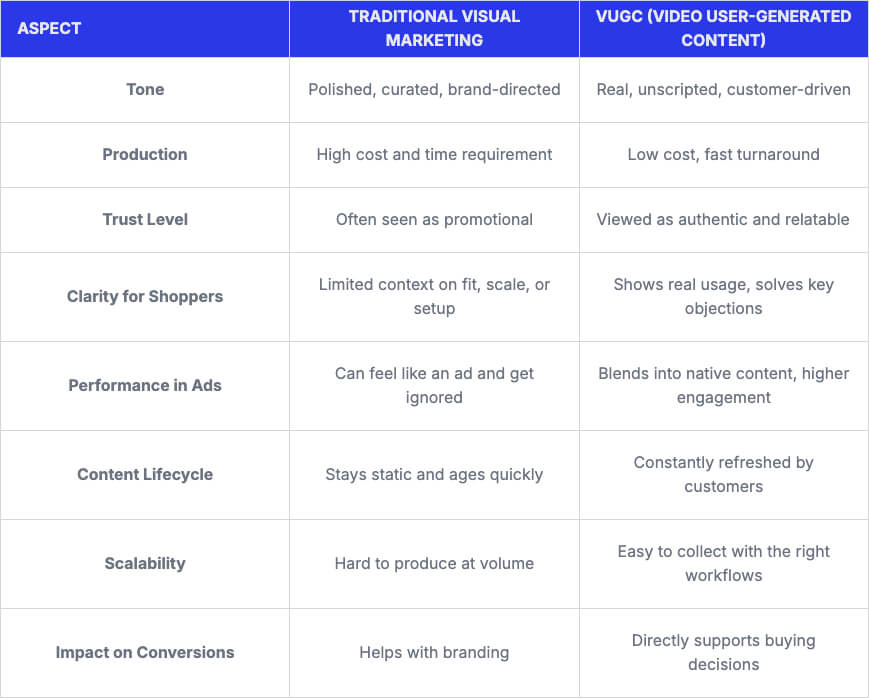
When brands talk about improving their visual marketing, they often think about better photography, cleaner design, or more polished product videos. Those pieces help, but they don’t always answer the questions shoppers actually have. That’s where VUGC fills the gap.
VUGC works so well because it mirrors the way people make decisions today. Shoppers trust real customers more than polished branding, so seeing someone use the product in their own space immediately lowers hesitation. It gives buyers the kind of real-world context they can’t get from a studio shot or a traditional product video.
There’s also a practical upside. VUGC covers the moments where polished visuals usually fall short:
- Showing how the product works after a few uses.
- Demonstrating fit, texture, or scale in a way photos can’t.
- Answering common questions that stop people from checking out.
- Giving shoppers a range of voices and scenarios instead of a single perfect presentation.
These videos do well because they focus less on looking perfect and more on helping someone understand the product. That clarity builds confidence. And when shoppers feel confident, they convert at a much higher rate.
For many brands, VUGC becomes the missing piece that turns a strong visual identity into a visual marketing system that actually drives sales. It fills the trust gap, supports comparisons, and makes the buying journey feel more human.
The key elements of effective VUGC
Good VUGC doesn’t happen by accident. The videos that perform best usually share a few simple traits that make them clear, helpful, and easy for shoppers to relate to. When brands understand these elements, it becomes much easier to collect VUGC that actually moves the needle.
Content types that consistently work
Certain formats naturally answer the questions shoppers care about most. Quick testimonials, product walkthroughs, unboxings, before and after clips, lifestyle demos, and comparison videos all tend to perform well because they show the product in action instead of just talking about it. Each format gives shoppers a different kind of insight, which helps reduce uncertainty.
Real creators with real experience
The best VUGC usually comes from customers, ambassadors, or micro-creators who have actually used the product. You don’t need big influencers. You need people who can speak honestly about what they like and show others how they use it. That relatability carries more weight than production value.
Clarity and pacing
The video doesn’t need to be fancy, but it should be easy to follow. A few seconds of context, a quick demo, and a clear explanation of why the product helps them is usually enough. Short, focused clips tend to hold attention better than heavily scripted videos.
Answering real buyer questions
The strongest VUGC does more than show the product. It addresses the things shoppers worry about before buying. How does it fit? What does it look like in different settings? How long does it take to set up? These small details help someone imagine owning the product, which leads to higher conversions.
Once brands know what makes VUGC effective, they can guide contributors without restricting creativity. It keeps the videos genuine while still giving shoppers the insights they’re looking for.
How to collect VUGC without friction
One of the biggest hurdles for brands isn’t understanding the value of VUGC. It’s getting enough of it, consistently, without chasing customers or managing a messy process in the background. The good news is that collecting great VUGC doesn’t have to be complicated.
Make it easy for customers to submit
People are far more willing to record a quick video when the submission flow is simple. A clear prompt, a mobile-friendly upload page, and a short list of guidelines can dramatically increase participation. The fewer steps, the more content you’ll receive.
Ask at the right moments
Timing matters. Customers are more likely to share videos right after they receive the product, after they’ve used it for a bit, or when they leave a review. Well-placed prompts in email flows or post-purchase messages can make a big difference.

Give contributors simple direction
You don’t need a script, but you do need clarity. Let people know what would be helpful to cover: show how they use the product, mention their favourite feature, highlight something that surprised them. These light guardrails keep the content useful while still feeling natural.
Avoid the manual back-and-forth
Collecting videos through scattered emails or DMs becomes unmanageable fast. Structured tools make it easier to gather content, organize submissions, and keep everything in one place. Platforms like Moast help brands collect authentic customer videos directly from their shoppers and streamline the experience so nothing slips through the cracks.
Encourage repeat creators
Some customers love sharing their experiences. When you make the process easy and enjoyable, many of them will submit more than once. Over time, this builds a steady pipeline of authentic VUGC that you can use across your visual marketing.
A smooth collection flow means you spend less time chasing content and more time putting it to work where it matters most.
Ways to turn VUGC into high-performing visual marketing assets
Play 1: Drop VUGC right where shoppers hesitate
Think about the questions customers ask before they buy. Will it fit? How hard is setup? What does it look like in real lighting? A single customer video on your product page can answer all of those instantly. It gives shoppers the confidence they need at the exact moment they’re thinking about checking out.
Play 2: Turn customer videos into shoppable experiences
Instead of treating VUGC as something people watch and move on from, make it part of the shopping flow. Tools like Moast let you turn customer clips into clickable videos that show the products featured inside the content. Shoppers watch, click, and continue browsing without losing momentum.
Play 3: Use VUGC to inspire your ad creative
Your best ad angles are already sitting on your website. If a video gets strong watch time or leads to more add-to-cart actions, that’s a signal it could perform well as a paid ad. This approach saves money and reduces guesswork since you’re only promoting proven concepts.
Play 4: Build VUGC into your lifecycle emails
Welcome flows, abandoned cart reminders, and product education emails all get stronger when a real customer shows the product in action. These videos make the email feel more personal and help shoppers understand what buying solves for them.
Play 5: Create themed collections of VUGC
If you have multiple videos around a specific benefit or feature, group them into a focused landing page. For example: “How customers style this,” “How people set it up,” or “Real customers explaining sizing.” These pages work well for campaigns, launches, and SEO.
Play 6: Repurpose VUGC across social without overthinking it
VUGC feels native on TikTok, Instagram, and YouTube Shorts. Posting these clips regularly builds a consistent visual identity and keeps the brand discoverable without big production costs.
Each of these plays turns everyday customer videos into assets that work across your entire visual marketing system. When VUGC lives in more than one channel, it becomes one of the highest-impact tools a brand can rely on.
Metrics that show whether your visual marketing is working
Once VUGC becomes part of your visual marketing system, the next step is knowing which videos actually influence buying decisions.The good news is that you don’t need complicated dashboards or dozens of KPIs to figure this out. A handful of practical metrics can give you a clear picture of what’s resonating with shoppers.
Watch time and completion rate
If people stop watching within the first two seconds, the video isn’t connecting. Strong watch time usually signals that the content feels relevant, helpful, or entertaining enough to hold attention.
Clicks and product interactions
When a video drives clicks on a product card, variant option, or call-to-action, it shows the content helped someone move from browsing to evaluating. This is especially important for shoppable video experiences.
Add-to-cart influence
If shoppers add a product to their cart after engaging with a video, that video is doing real lifting. It’s a sign that the content answered a key question or removed hesitation.
Conversion influence
Looking at how often a video appears in the journeys of buyers versus non-buyers is one of the clearest signals of impact. Videos that consistently show up in purchasing sessions often become your best-performing assets.
Content-level comparisons
When you compare videos side by side, patterns start to emerge. Certain formats, creators, or talking points will stand out as top performers. This lets you double down on what works instead of guessing.
Tools like Moast help brands track these metrics at the video level so you can see which pieces of VUGC help shoppers take the next step. When your visual marketing becomes measurable, it becomes much easier to improve over time.
Examples of brands using VUGC to lift conversions
Here are real situations where brands leaned into VUGC to strengthen their visual marketing and influence buying decisions.
- Customers record quick walkthroughs showing how they rig their kayaks, store gear, and set up seats.
- These clips help shoppers understand weight, size, stability, and accessories better than static photos ever could.
- Result: more confident buyers, especially for higher-ticket models.
- Shoppers often wonder how tricky it is to install the motorized wheel on their golf cart.
- Customer videos showing the five-minute setup became some of the most-watched assets on their Moast widget.
- Result: fewer questions before purchase and a significant lift in conversion.
- Their heated outdoor furniture is a premium investment, so buyers want to see how it performs in real backyards.
- Customer videos highlight heating speed, comfort, and everyday use.
- Result: better educated shoppers and smoother sales conversations.
- Beauty shoppers rely heavily on texture, consistency, and before/after comparisons.
- Fushi’s VUGC clips show customers applying oils and supplements while explaining results in simple language.
- Result: higher add-to-cart rates on products where video clarity replaces guesswork.
- With thousands of SKUs, discovery can be overwhelming.
- Customers share short “taste test” videos that help highlight seasonal products, new arrivals, and candy bundles.
- Result: more time spent on product pages and higher engagement with featured items.
- Their hand-painted jackets look different in every lighting condition.
- Customer try-on videos show colour, fit, and movement in a natural way.
- Result: fewer sizing questions and stronger purchase confidence.
These real examples show how VUGC adapts to different industries but delivers the same outcome: shoppers get the clarity they need from people they relate to, which leads to better conversion performance.
How to build your own visual marketing system with VUGC
A strong visual marketing strategy doesn’t rely on random videos showing up from customers. It works best when everything follows a simple, repeatable system that helps you collect content, use it in the right places, and learn what performs well. Here’s a straightforward way to build that system.
Step 1: Map out the questions shoppers ask before buying
Think about the moments of hesitation buyers face. Fit, setup, durability, performance, size, texture, comparisons. These are the topics your VUGC should cover because they remove friction in the buying journey.
Step 2: Collect content that answers those questions
Once you know what people need clarity on, it becomes easier to guide customers when asking for videos. A simple prompt like “Show how you set it up” or “Explain what made you choose this model” gives you content that directly supports conversion.
Step 3: Place VUGC in the spots that matter most
Your highest-intent real estate is your product pages, landing pages, and key email flows. Start there. Adding VUGC at these touchpoints makes the buying decision feel easier and faster since shoppers don’t have to search for answers elsewhere.
Step 4: Use shoppable formats to connect viewing with action
If your videos are interactive, they do more than educate—they guide shoppers deeper into the experience. Moast’s shoppable video widgets are built for this flow, letting viewers click on the products inside a video and continue browsing without friction.
Step 5: Track per-video performance and learn from it
Once VUGC is live, your metrics start telling you what works. If certain videos drive more clicks, add-to-cart actions, or longer watch time, use those as templates for future content. Over time, you’ll see patterns in what your audience responds to.
Step 6: Refresh your visual library regularly
VUGC naturally becomes more powerful when it's ongoing rather than episodic. A steady pipeline of customer videos keeps your visuals fresh and helps the brand stay connected to real user experiences.
By following a simple loop—collect, publish, analyze, repeat—you end up with a visual marketing system powered by VUGC that gets stronger over time instead of going stale.
Conclusion
Visual marketing has changed a lot over the past few years, and shoppers now expect to see real people using real products before they commit. That’s why VUGC has become such an important part of how ecommerce brands build trust and guide buyers toward a decision. It gives shoppers the kind of clarity and reassurance polished visuals rarely provide.
When you treat VUGC as part of a larger visual marketing system, it becomes easier to collect the right content, place it where it matters, and learn which videos actually influence conversions. Over time, this creates a steady flow of authentic visuals that support every stage of the buying journey.
If your goal is higher conversion rates and more confident customers, VUGC is one of the simplest ways to get there. A few honest videos from real users can do more for your brand than another round of studio shots. And once you build a repeatable process around it, your visual marketing becomes a much more powerful engine for growth.
Related content
.jpg)


Turn your social content into a revenue channel
Turn your TikToks and Reels into shoppable videos and boost conversions by 3.5x.