


- The Way Shoppers Find Products Is Changing Fast
- What AI Discoverability Actually Means
- Why Shoppable Video Creates Stronger AI Signals Than Text Alone
- Structured Data Is the Layer Most Brands Are Missing
- The Long-Tail Content Advantage of a Video Library
- How Shoppable Video Connects to Your Broader SEO and Retention Strategy
- Which Types of Shoppable Video Drive the Most Discoverability Value
- What to Do Right Now: A Practical Action List
- The Compounding Effect: Why Starting Now Matters
The Way Shoppers Find Products Is Changing Fast
If you run a Shopify store, you've probably noticed that the old playbook for getting discovered is not working as well as it used to. Paid ads are more expensive. Organic search is more competitive. And now there's a new variable that most brand owners are not thinking about yet: AI-powered search.
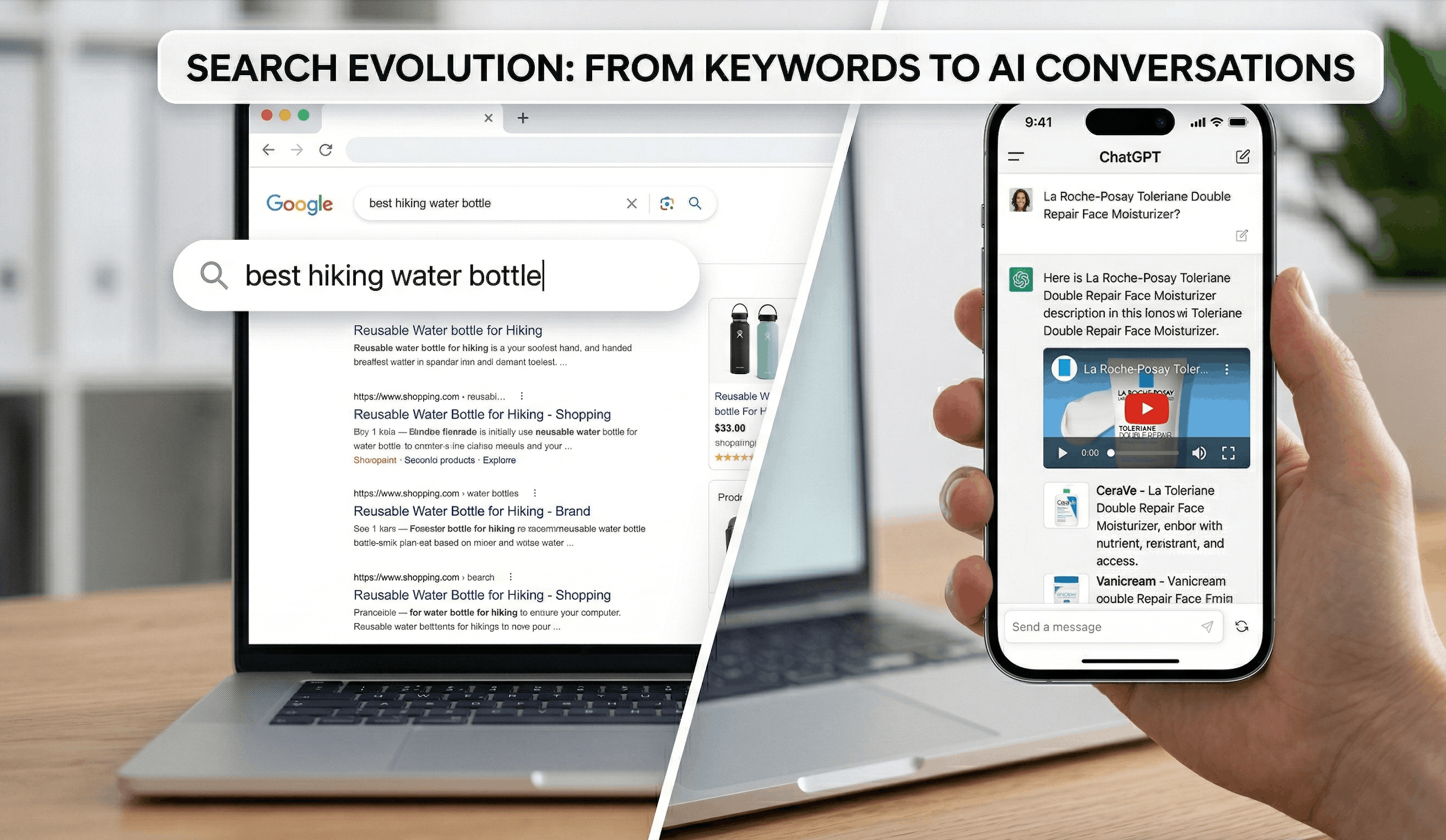
Tools like ChatGPT, Google's AI Overviews, and Perplexity are increasingly the first place people go when they want a product recommendation. Instead of typing keywords into a search bar and scrolling through results, shoppers are asking conversational questions and getting direct answers. "What's a good reusable water bottle for hiking?" or "Which skincare brand is best for dry, sensitive skin?" — and the AI answers with specific brand and product mentions.
The brands that show up in those answers are not necessarily the ones with the biggest ad budgets. They're the ones with the richest, most trustworthy, most structured content. And shoppable video — especially user-generated shoppable video — is one of the most powerful ways to build exactly that kind of content depth.
This post explains the mechanics of how shoppable video influences AI discoverability, what signals actually matter, and what you should be doing about it right now.
What AI Discoverability Actually Means
Let's be clear about what we mean when we say AI discoverability. It is not just about ranking on Google anymore. It's about whether your brand gets mentioned or recommended when someone uses an AI assistant to research or buy a product.
These AI systems — whether they're powering Google's Search Generative Experience, Perplexity's answers, or ChatGPT's shopping suggestions — are pulling from a wide range of signals. They look at structured data on your pages, the quality and specificity of your content, how other sites link to and talk about your brand, engagement signals, and the semantic richness of what you publish.
According to Shopify's ecommerce SEO guide, content depth and structured data are increasingly critical factors in how product pages perform in search — and that logic extends directly into how AI models interpret and prioritize brand content when generating answers.
The brands that win in AI-driven discovery have a content profile that is specific, structured, and trustworthy. Shoppable video, when implemented correctly, builds all three of those qualities simultaneously.
Why Shoppable Video Creates Stronger AI Signals Than Text Alone
Most brand owners think of shoppable video as a conversion tool — something that helps shoppers on the fence make a decision. And it absolutely does that. But it also generates a layered set of content signals that AI systems are specifically designed to recognize and reward.

Video Transcripts Add Semantic Depth to Your Pages
Every shoppable video that includes a transcript or closed captions is adding indexable, natural-language text to your product pages. This matters more than most people realize. When a real customer says in a video, "I've been using this serum every night for six weeks and my dark spots have faded noticeably," that sentence is packed with semantic meaning: product type, use case, duration, specific outcome. That is exactly the kind of specific, human content that AI systems are trained to recognize as authoritative and relevant.
Compare that to a generic product description that says "reduces the appearance of dark spots." The video transcript is richer, more specific, and reads more like verified human experience — which performs better in both traditional and AI-powered search contexts.
Engagement Signals Tell AI Systems Your Content Is Worth Surfacing
AI systems do not evaluate content in a vacuum. They pay attention to behavioral signals — how long people stay on a page, how they interact with content, whether they return. HubSpot's marketing research consistently shows that video content dramatically increases time-on-page compared to text-only pages. When shoppers watch a shoppable video on your product page, they stay longer and engage more. Those signals feed into quality assessments that influence how your content is ranked and surfaced.
User-Generated Content Reads as Third-Party Validation
AI systems trained on human-generated content are increasingly good at distinguishing between polished brand copy and genuine customer voices. User-generated shoppable video — real customers, real language, real experiences — carries more weight as a trust signal than brand-produced content alone. It functions like a review, but richer and more credible. Learn more about how UGC video works for Shopify brands and why it matters beyond just conversion rates.
Structured Data Is the Layer Most Brands Are Missing
Here is where a lot of Shopify brands leave significant discoverability value on the table. Structured data — schema markup — is the way you communicate to search engines and AI systems exactly what your content is about, in a format they can parse without ambiguity.
When shoppable video is embedded on your product pages alongside proper schema implementation, you create a multi-layered signal cluster that AI systems find highly useful. Specifically, combining VideoObject schema with Product schema and Review schema tells any system crawling your page several things at once: what the product is, who has used it, what their experience was, and that there is video content verifying those claims.
According to research from the Baymard Institute, product pages with rich media and verified social proof see meaningfully higher conversion rates — and the same principle applies to discoverability. Richer, more structured content gives AI systems more high-quality material to work with, which increases the probability that your brand surfaces in relevant AI-generated answers.
If you have not audited your schema markup recently, that is worth doing this week. Pair it with shoppable video content and you are creating a content signal depth that is genuinely hard to replicate quickly.
The Long-Tail Content Advantage of a Video Library
One of the most practical and underappreciated benefits of building a shoppable video library is the long-tail content it generates naturally. Here is what that looks like in practice.
When you collect shoppable videos from real customers, each video covers slightly different ground. One customer talks about how a product fits in their daily routine. Another mentions how it performed during travel. A third describes using it in a specific context — postpartum recovery, high-altitude hiking, professional kitchen use. Each of those videos represents a distinct cluster of long-tail queries that someone might ask an AI assistant.
Over time, a library of shoppable videos creates a dense web of specific, contextual, query-relevant content across your product catalog. This is exactly the content footprint that AI systems reward when generating answers to nuanced, specific questions. It is also why building a shoppable video strategy is not just a conversion play — it is a long-term content moat.
How Shoppable Video Connects to Your Broader SEO and Retention Strategy
Shoppable video does not operate in isolation. It plugs into and amplifies your existing SEO and retention efforts in concrete ways.
It Upgrades Thin Product Pages Fast
Thin product pages — minimal text, generic descriptions, no rich media — are increasingly penalized by both Google and AI systems. Adding shoppable video to your product pages immediately increases page depth, dwell time, and content variety. It is one of the fastest ways to meaningfully improve the content quality of pages that have historically been weak performers.
It Generates Backlinks and Social Signals
Compelling video content gets shared. When customers share their video reviews on social platforms and tag your brand, or when that content is embedded and linked from external sites, you accumulate backlinks and social signals that contribute to domain authority. Higher domain authority means better baseline discoverability in both traditional and AI-powered search.
It Strengthens Email Performance
Klaviyo's email benchmarks show that including video content in email campaigns drives meaningfully higher engagement. When you repurpose your shoppable video content in post-purchase flows, browse abandonment sequences, and re-engagement campaigns, the engagement lift compounds across channels. More email engagement generates more on-site sessions, which generate more behavioral signals, which feed back into your overall content performance profile.
For a practical look at how to connect video content with your email strategy, this guide on video and email strategy is a useful starting point.
Which Types of Shoppable Video Drive the Most Discoverability Value
Not all video content delivers the same discoverability benefit. Based on what we know about how AI systems evaluate content quality and relevance, certain formats consistently perform better.

Customer Testimonial Videos
These are the highest-value format for AI discoverability. Real people, using real language, describing real experiences. The semantic richness of this content — specific outcomes, product details, context of use — is exactly what AI systems are trained to recognize as authoritative and trustworthy. A single well-indexed customer testimonial video can surface for dozens of specific long-tail queries.
Use-Case and How-To Videos
Videos showing a product being used in a specific context capture long-tail intent naturally. Someone asking an AI assistant "what's a good coffee grinder for single-origin pour-over" is far more likely to encounter your brand if you have video content showing that exact use case. These videos match high-specificity queries that generic product descriptions can never address.
Before-and-After and Transformation Videos
These address evaluation-stage queries directly. When someone is comparing options and trying to understand what results they can expect, transformation videos speak precisely to their intent. AI systems are increasingly good at matching query intent to content type, and these videos are built for the evaluation stage of the purchase journey.
For guidance on how to systematically collect these formats from your existing customers, this guide on collecting customer videos covers the practical steps.
What to Do Right Now: A Practical Action List
The shift toward AI-driven discovery is not a future trend you can monitor from a distance. It is happening now, and the brands building content depth today will have a structural advantage over those that start later. Here is a concrete action list for Shopify brand owners and ecommerce managers.
- Audit your top product pages. Identify your 10 to 20 highest-revenue products and assess whether they have any video content. These are your highest-priority targets for shoppable video.
- Start collecting customer videos systematically. Use a platform built for Shopify to request and collect video testimonials from real customers. Even three to five videos per product creates a meaningful content signal that compounds over time.
- Implement structured data properly. Ensure that VideoObject schema, Product schema, and Review schema are correctly implemented on pages where you have video content. This is what turns your content into a parseable signal for AI systems.
- Optimize your video transcripts. Make sure your video platform generates accurate transcripts. These are the raw, indexable text that AI systems read. If your transcripts are inaccurate or missing, you are leaving significant value on the table.
- Repurpose video across channels. Do not let shoppable video content live only on your product pages. Push it into email flows, social content, and paid creative. Every additional touchpoint generates additional engagement signals.
- Track page-level performance metrics. Monitor dwell time, bounce rate, and pages per session on product pages where you have added video. You should see measurable improvement within 60 to 90 days of consistent implementation.
According to Shopify's video marketing guidance, brands that integrate video into their product pages see meaningful lifts in both conversion rate and organic traffic — and those lifts compound as the content library grows.
The Compounding Effect: Why Starting Now Matters
There is a compounding dynamic at work here that makes timing genuinely important. AI systems do not just read your content today — they build an ongoing understanding of your brand's authority and relevance over time. A brand that starts building a shoppable video content library now will have a meaningful head start over one that starts in 12 months.
Every video you collect and publish is a permanent content asset. It is indexed, it generates engagement signals, it builds semantic authority in your product category, and it compounds. A library of 50 customer videos across your catalog creates a content depth that is genuinely difficult for competitors to replicate quickly — and it is exactly the kind of content profile that AI systems recognize as authoritative.
The brands that win the AI discoverability game over the next two to three years will be the ones that built their content foundations during this window, when the competition for this space is still relatively low. Shoppable video is a core part of that foundation.
If you are ready to start building that foundation for your Shopify store, this getting started guide walks through exactly how to set up and launch your first shoppable video campaign on Moast.
Related content
.jpg)


Turn your social content into a revenue channel
Turn your TikToks and Reels into shoppable videos and boost conversions by 3.5x.