


- Introduction: The Shift Toward Agentic Commerce
- What Is Agentic Commerce?
- Why Agentic Commerce Is Emerging Now
- How AI Shopping Agents Actually Work
- How Agentic Commerce Will Change Product Discovery
- Why Traditional SEO Is No Longer Enough
- The Types of Content AI Shopping Agents Prefer
- How Shopify Brands Can Start Preparing Today
- The Role of Video and Social Proof in Agentic Commerce
- What the Future of Ecommerce Discovery Looks Like
- Final Thoughts: Preparing Your Store for the Next Era of Ecommerce
The way people discover and buy products online is changing faster than at any point in ecommerce history.
For the past two decades, online shopping has been built around a simple model: a customer searches for something, browses results, compares options, and eventually purchases a product.
But a new paradigm is emerging—one where customers may no longer do most of the searching themselves.
Instead, AI agents will increasingly handle the entire shopping process on their behalf.
This shift is known as agentic commerce, and it represents the next evolution of digital retail.
Rather than manually browsing dozens of product pages, consumers will simply tell an AI assistant what they want. The AI agent will research options, compare products, evaluate reviews, and even complete the purchase automatically.
For ecommerce brands—especially those running stores on Shopify—this raises an important question:
How do you make sure your products are the ones AI agents choose?
Preparing for agentic commerce requires a new way of thinking about product discovery, content structure, and digital marketing. Traditional SEO and product page optimization will still matter, but new factors will begin influencing which products appear in AI-powered recommendations.
In this guide, we’ll explore what agentic commerce is, why it’s emerging so quickly, and how Shopify brands can start preparing for a world where AI agents play a central role in the buying journey.
Introduction: The Shift Toward Agentic Commerce
For years, ecommerce growth has been driven by improvements in search engines, social media, and recommendation algorithms.
But AI is now reshaping how consumers interact with the internet itself.
Today, many shoppers already rely on AI tools to help them make purchase decisions. According to industry research, 64% of shoppers use AI to research products and 54% rely on chatbots or AI assistants to help decide what to buy. (Salsify)
These tools are evolving quickly. What started as simple chatbots is becoming something far more powerful: autonomous agents capable of completing complex tasks.
This transformation is driving the rise of agentic commerce.
In this new model, AI doesn’t just help consumers search—it actively participates in the buying process.
These agents can:
- understand a shopper’s intent
- compare products across multiple stores
- evaluate reviews and specifications
- recommend the best option
- complete transactions automatically
Instead of browsing websites themselves, shoppers will increasingly rely on AI to handle these steps.
Major technology companies are already building the infrastructure to support this future.
AI shopping capabilities are emerging inside platforms like conversational assistants, search engines, and messaging apps. Some AI systems can already recommend products and complete purchases directly within the interface. (McKinsey & Company)
For ecommerce brands, this means product discovery will gradually move away from traditional search results and toward AI-mediated recommendations.
Understanding this shift early gives Shopify merchants a major advantage.
What Is Agentic Commerce?
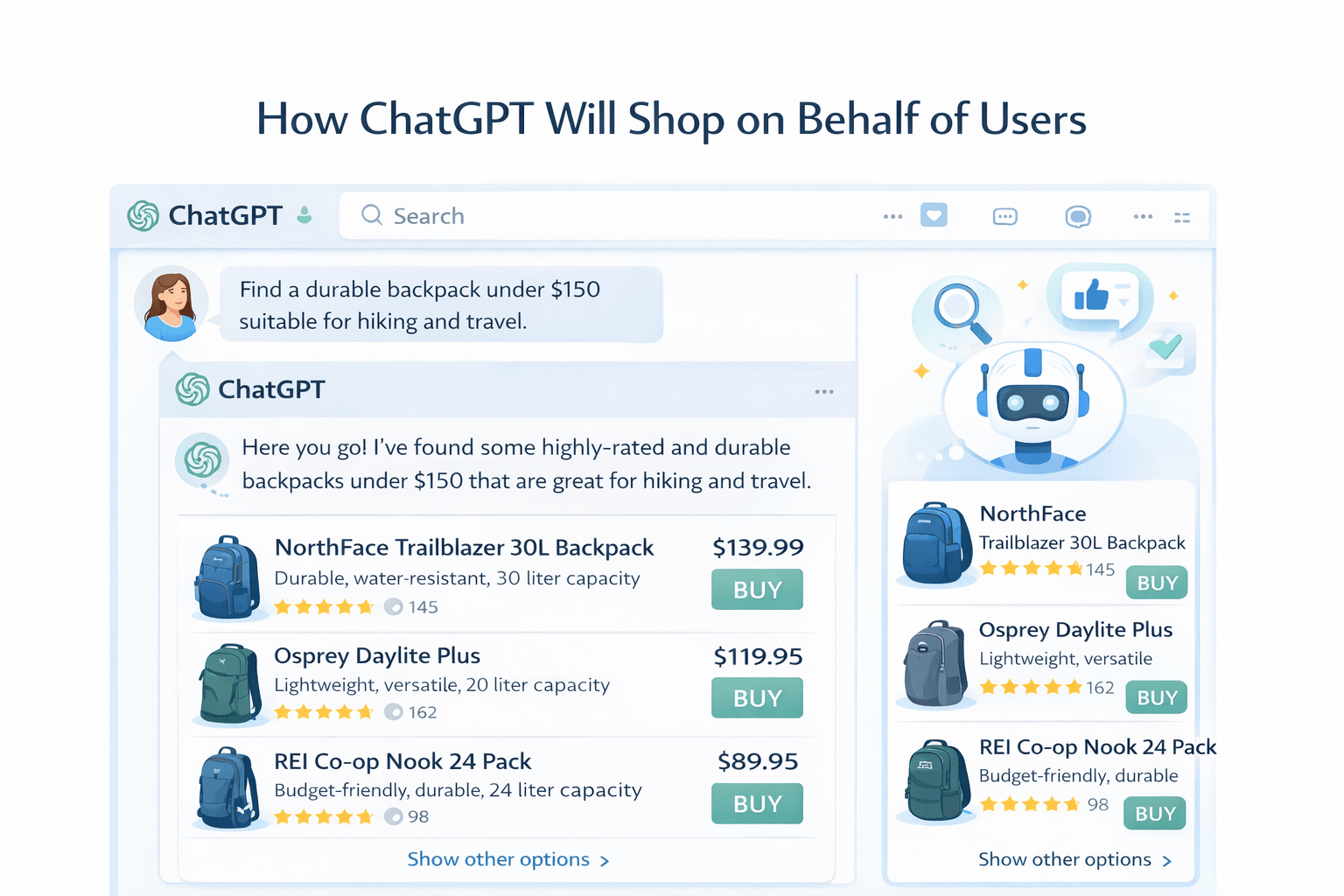
Agentic commerce refers to a new model of buying and selling where AI agents act on behalf of consumers to research, evaluate, and complete purchases. (IBM)
Unlike traditional ecommerce interactions—where humans click through websites and product pages—agentic commerce delegates much of the shopping process to software.
An AI shopping agent can interpret a user’s request, analyze product data, and recommend the best option based on the shopper’s preferences and goals.
These agents are more sophisticated than traditional chatbots.
While chatbots typically answer questions or provide information, AI agents can plan actions and execute tasks autonomously. (Alhena)
In practical terms, this means an AI shopping agent could handle an entire purchase workflow.
For example:
A consumer might tell their AI assistant:
“Find the best organic baby formula under $40 and order it.”
The AI agent would then:
- Search across multiple retailers
- Compare product ingredients and reviews
- Evaluate pricing and availability
- Select the best option
- Place the order automatically
The user never needs to browse websites or read product pages.
The agent does the work.
For brands, this means that AI systems will increasingly become the gatekeepers of product discovery.
Instead of optimizing content only for human shoppers, brands will also need to optimize for machine understanding.
Why Agentic Commerce Is Emerging Now
Several technological and behavioral trends are converging to accelerate the rise of agentic commerce.
Rapid advancements in generative AI
Large language models have dramatically improved the ability of machines to understand human intent and process complex information.
This allows AI systems to interpret vague shopping requests and turn them into structured product searches.
The rise of AI assistants
AI-powered assistants are already integrated into many everyday tools.
From voice assistants to chatbots embedded in messaging platforms, consumers are becoming comfortable interacting with AI when completing tasks online.
Consumer demand for convenience
Shopping online can still be time-consuming.
Consumers often compare dozens of product pages before making a purchase decision.
AI agents promise to dramatically reduce this friction.
Instead of spending 30 minutes researching products, a shopper could simply ask an AI assistant to handle the process.
Massive growth in AI-driven discovery
Traffic from AI-powered shopping assistants is already increasing rapidly. Some reports suggest traffic from generative AI tools to retail sites has grown more than 1,300% year over year. (AlixPartners)
This trend suggests that AI-driven product discovery will soon become a mainstream shopping behavior.
For Shopify merchants, preparing for that shift now will make it much easier to adapt as adoption grows.
How AI Shopping Agents Actually Work
To prepare for agentic commerce, it’s helpful to understand how AI shopping agents make decisions.
These systems typically follow a multi-step process.
Understanding the user’s intent
First, the AI agent interprets the user’s request.
For example:
“Find a durable backpack for traveling under $150.”
The AI extracts key criteria:
- product type (backpack)
- purpose (travel)
- feature requirement (durable)
- price constraint ($150)
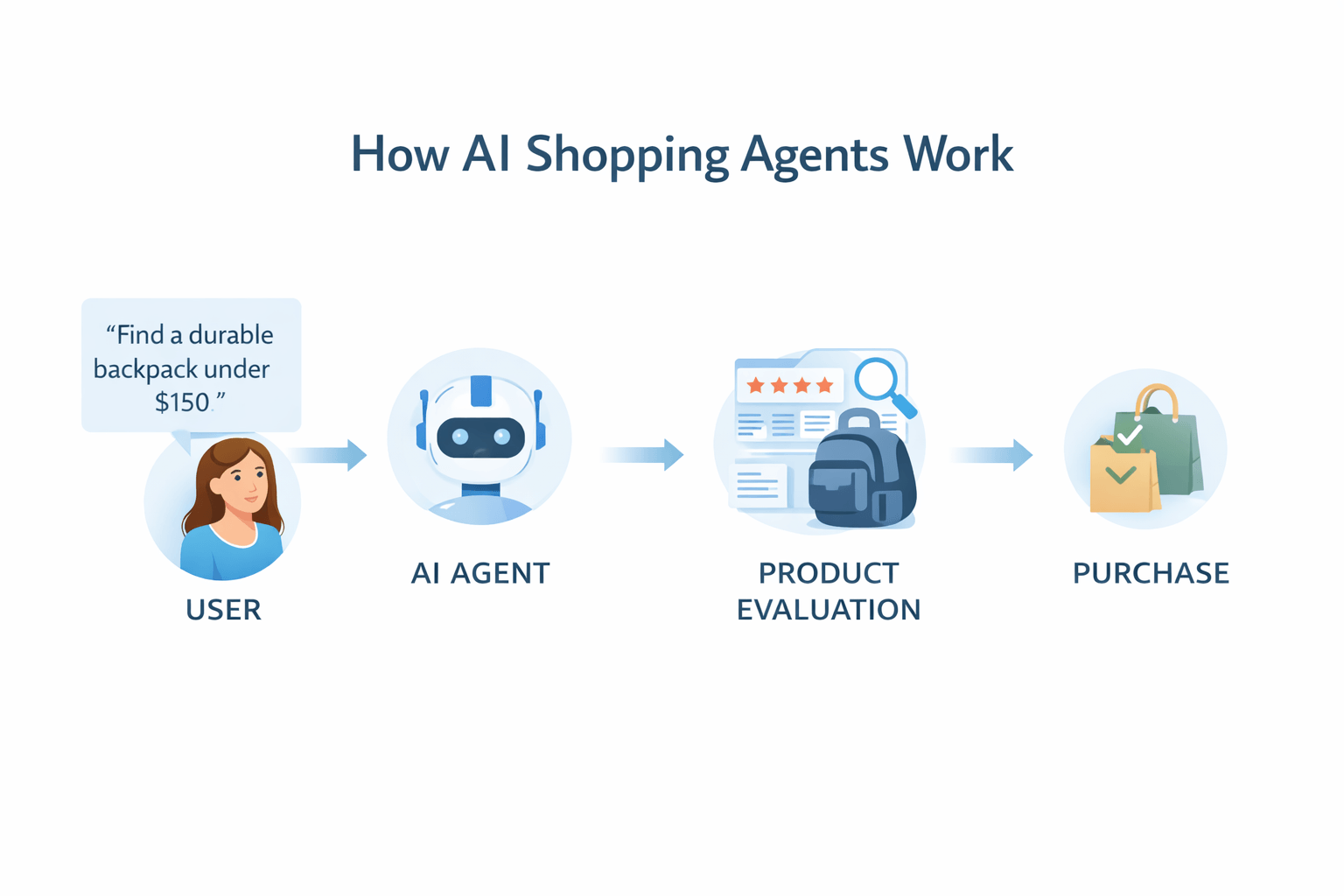
Gathering product data
Next, the agent collects product information from multiple sources.
These may include:
- e-commerce product pages
- merchant catalogs
- structured product feeds
- customer reviews
- marketplace listings
Evaluating options
The agent then evaluates products using a combination of factors.
These may include:
- specifications
- pricing
- availability
- review sentiment
- brand reputation
Recommending products
Finally, the AI agent presents one or more recommended options.
In some cases, it may even complete the purchase directly.
The entire process can happen in seconds.
This means that brands will increasingly compete not just for consumer attention—but also for algorithmic selection by AI agents.
How Agentic Commerce Will Change Product Discovery

Traditional ecommerce discovery relies heavily on search engines and marketplaces.
Consumers type queries into Google or Amazon and browse through ranked results.
Agentic commerce fundamentally changes that process.
Instead of searching for products directly, shoppers will interact with AI assistants.
These assistants will generate product recommendations based on the user’s request.
As a result, product discovery may shift from:
“Which product ranks highest in search results?”
to
“Which product does the AI agent recommend?”
This creates a new competitive dynamic.
Instead of optimizing only for search algorithms, brands must optimize for AI comprehension.
AI agents must be able to:
- interpret your product information
- understand its benefits
- compare it with alternatives
- trust its credibility
Brands that provide clear, structured, and authoritative information will have a higher chance of being recommended.
Why Traditional SEO Is No Longer Enough
Search engine optimization has been the cornerstone of ecommerce marketing for years.
But the rise of AI-driven discovery is creating a new discipline known as Generative Engine Optimization (GEO).
GEO focuses on optimizing content so that AI systems can retrieve, understand, and reference it when generating answers.
Unlike traditional search engines, generative AI models do not simply rank pages by keywords and backlinks.
Instead, they prioritize information that is:
- highly structured
- contextually clear
- semantically meaningful
- authoritative
This means brands must begin structuring product information in ways that machines can easily interpret.
In an AI-driven shopping ecosystem, the brands that communicate their product value most clearly to machines will be the ones that surface in AI recommendations.
The Types of Content AI Shopping Agents Prefer
AI agents rely on multiple signals to determine which products to recommend.
Some of the most important include the following.
Structured product data
Machine-readable product data helps AI agents understand specifications quickly.
This includes information like:
- product features
- materials
- sizing details
- compatibility
- availability
Customer reviews
Authentic customer feedback provides important trust signals.
AI systems often analyze reviews to understand product quality and sentiment.
Expert or editorial content
Articles, guides, and reviews help provide additional context about a product’s value.
Visual and video content
Product videos help demonstrate how products work in real life.
AI models increasingly analyze multimedia content to better understand products.
Clear product descriptions
Descriptions that clearly explain a product’s purpose and benefits are easier for AI systems to interpret.
The more structured and informative your product content is, the more likely it is to appear in AI-generated recommendations.
How Shopify Brands Can Start Preparing Today
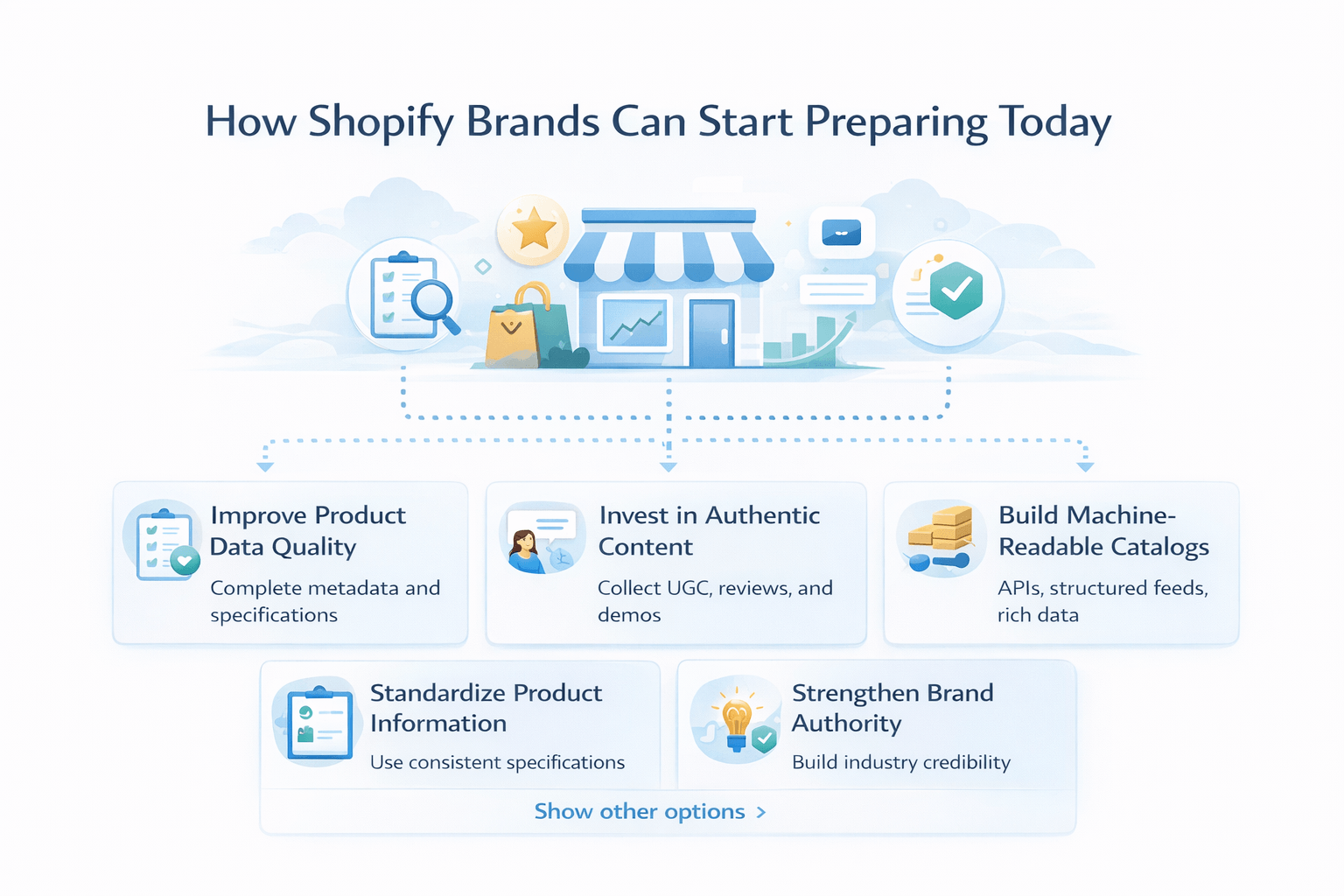
Although agentic commerce is still emerging, Shopify merchants can begin preparing immediately.
Here are several practical steps.
Improve product data quality
Ensure that product descriptions, specifications, and metadata are complete and accurate.
AI agents rely heavily on structured product information.
Standardize product information
Use consistent formats for specifications such as sizing, materials, and compatibility.
This makes product comparisons easier for AI systems.
Invest in authentic content
User-generated content, customer reviews, and product demonstrations provide valuable signals.
These signals help AI models understand product quality and customer satisfaction.
Strengthen brand authority
Brands with strong reputations and consistent messaging are more likely to appear in AI recommendations.
Thought leadership, educational content, and industry credibility all contribute to this.
Build machine-readable catalogs
Ensuring your catalog is accessible through APIs and structured data formats will make it easier for AI agents to evaluate your products.
The Role of Video and Social Proof in Agentic Commerce
One often overlooked aspect of AI-driven discovery is the importance of social proof.
AI systems evaluate not only product specifications but also customer sentiment and engagement signals.
Video content plays a powerful role here.
Short product videos demonstrate how a product works in real-world situations.
They also provide additional context that text descriptions alone cannot capture.
For example:
- product demonstrations
- customer testimonials
- unboxing videos
- comparison clips
These types of content help AI systems better understand product functionality and user satisfaction.
As AI shopping agents evolve, multimedia content may become an increasingly important signal for product evaluation.
What the Future of Ecommerce Discovery Looks Like
Over the next several years, the way consumers shop online will likely change dramatically.
Instead of navigating dozens of websites, shoppers may simply describe what they want to an AI assistant.
The assistant will then:
- analyze preferences
- evaluate product options
- negotiate pricing
- complete the purchase
In this environment, ecommerce brands will compete not only for customer attention but also for algorithmic selection.
The brands that succeed will be those that provide the clearest, most trustworthy information to AI systems.
Preparing for this shift now gives Shopify merchants a major competitive advantage.
Final Thoughts: Preparing Your Store for the Next Era of Ecommerce
Agentic commerce represents one of the most important shifts in ecommerce since the rise of search engines.
As AI shopping agents become more capable, they will increasingly act as intermediaries between consumers and brands.
This means that product discovery will no longer depend solely on search rankings or advertising budgets.
Instead, success will depend on how well your products can be understood, evaluated, and trusted by AI systems.
For Shopify merchants, the path forward is clear.
Focus on:
- structured product information
- authentic customer content
- rich multimedia experiences
- strong brand credibility
These signals will help ensure that when AI agents evaluate product options, your brand is one of the recommendations they present.
Agentic commerce is still evolving—but the brands that start preparing now will be best positioned to thrive in the next era of ecommerce.
Related content
.jpg)


Turn your social content into a revenue channel
Turn your TikToks and Reels into shoppable videos and boost conversions by 3.5x.