
- Introduction
- The Uber Partnership: Speed as a Baseline Expectation
- The Temu Integration: Demand Without the Discovery Grind
- The Common Thread: Shopify as the Orchestrator
- Why Optionality Is Becoming the Real Advantage
- What This Signals About the Direction of Commerce
- What Merchants Should Actually Take Away
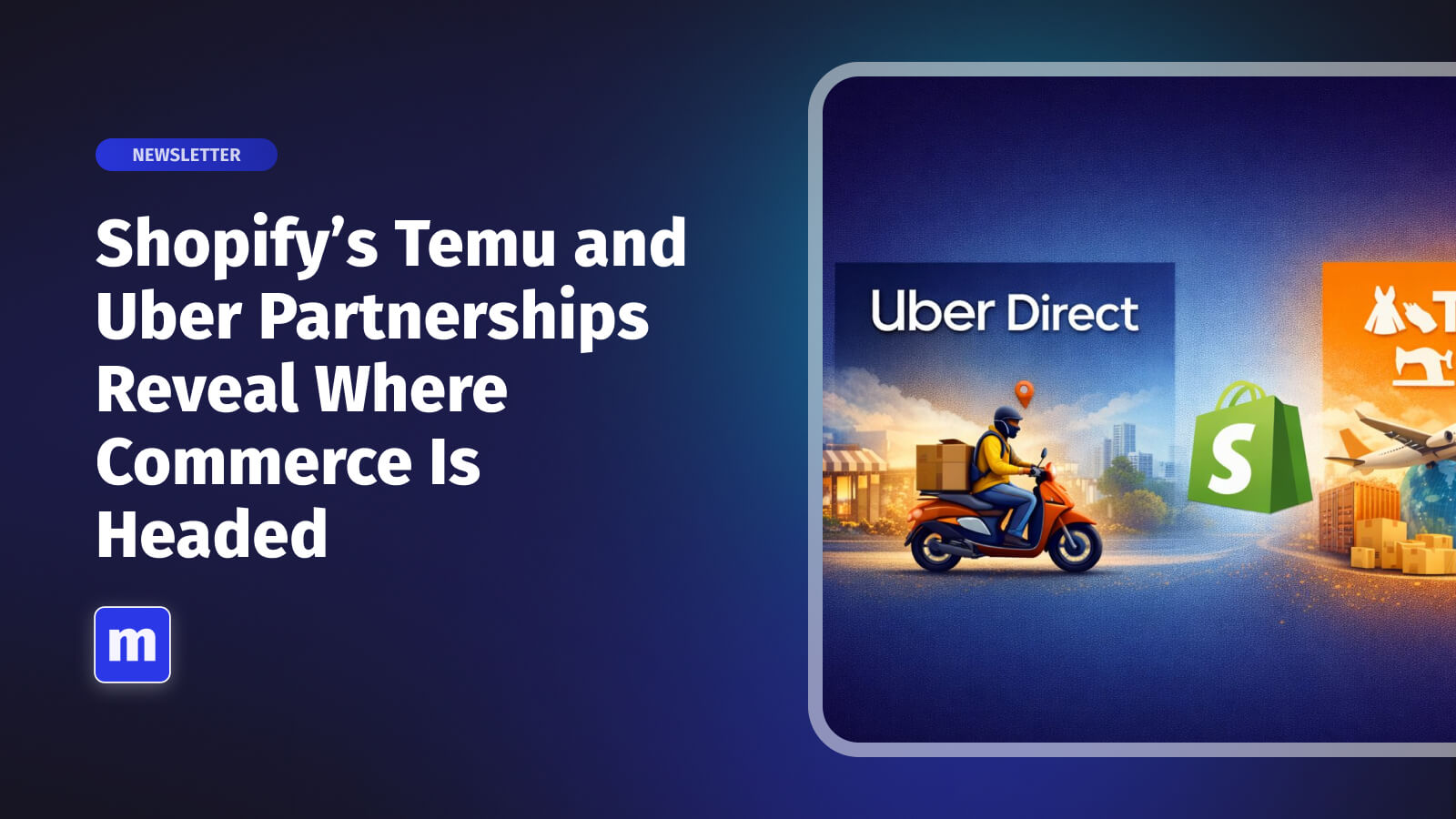
Shopify has rolled out two partnerships recently that, at first glance, feel unrelated.
One focuses on local, same-day delivery through Uber.
The other opens the door to cross-border marketplace distribution via Temu.
Different partners. Different use cases. Very different audiences.
But when you step back, these announcements tell a consistent story about how Shopify sees the future of commerce — and the role it wants to play inside it.
This is less about adding features and more about reshaping what “running a Shopify store” actually means.
The Uber Partnership: Speed as a Baseline Expectation
The Uber Direct integration is Shopify acknowledging a reality merchants have been feeling for years.
Shoppers increasingly expect:
- Faster delivery windows
- Local fulfillment options
- Amazon-level convenience, even from independent brands
For most merchants, meeting those expectations has traditionally meant tradeoffs. Expensive third-party logistics providers, complex courier setups, or operational overhead that only makes sense at scale.
Uber Direct changes that equation.
Read: 10 Ecommerce Best Practices for Shopify Success in 2026
By plugging into Uber’s existing courier network, Shopify merchants can offer same-day or on-demand local delivery without building anything custom. No new logistics team. No new fulfillment workflows. The checkout experience stays native to Shopify, while delivery speed improves dramatically.
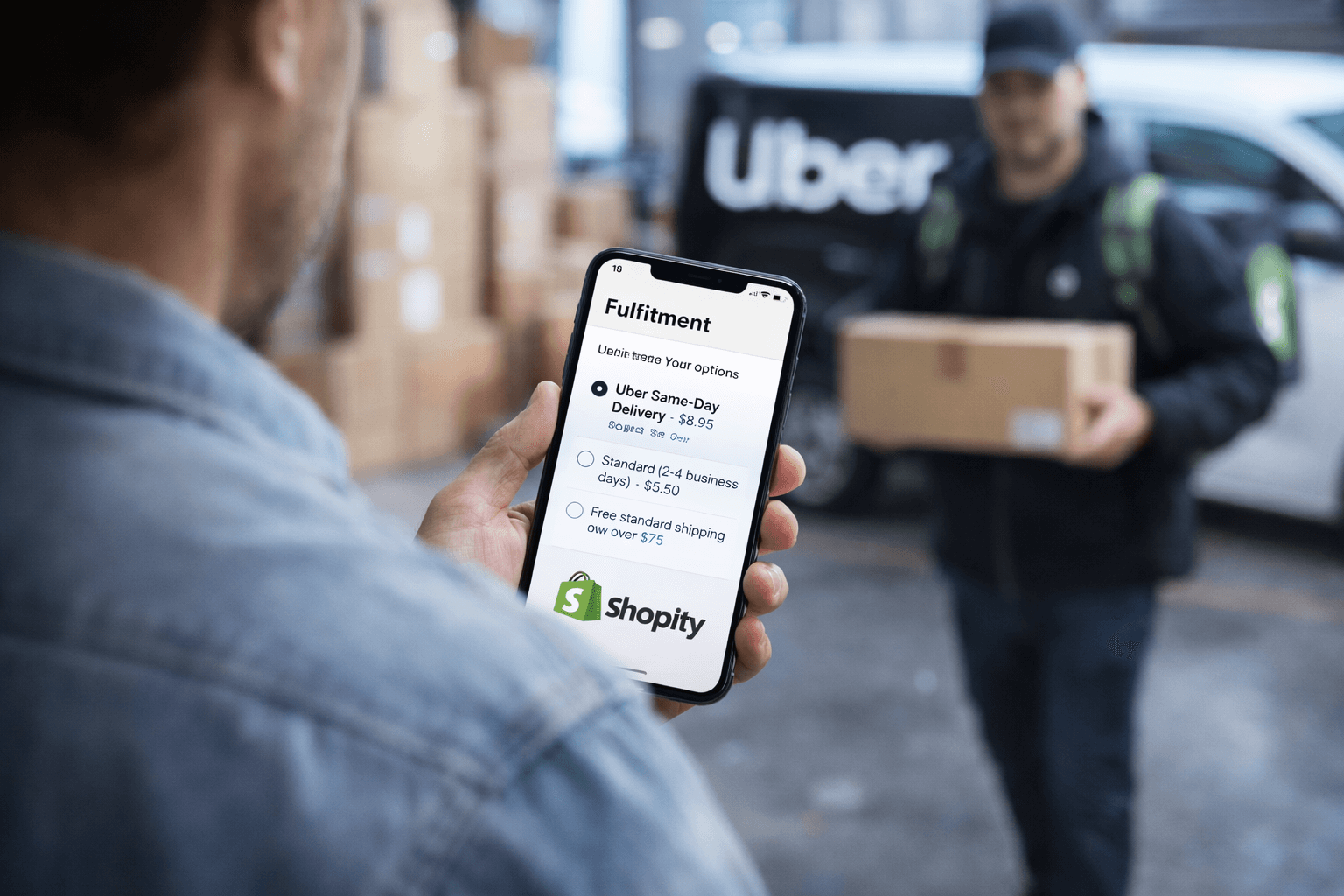
This matters because speed is no longer a differentiator — it’s becoming a requirement.
Shoppers don’t think in terms of fulfillment partners. They think in terms of “when does this arrive?” Shopify using Uber as infrastructure allows merchants to keep up with rising expectations without needing to become logistics experts.
The Temu Integration: Demand Without the Discovery Grind
If Uber represents speed, Temu represents reach.
Temu has grown by mastering one thing exceptionally well: product discovery at scale. It thrives on price-driven shopping, algorithmic merchandising, and a global audience already conditioned to browse.
For Shopify merchants, the Temu integration flips a familiar challenge on its head.
Instead of:
- Spending heavily to acquire traffic
- Fighting for attention across ads and social platforms
- Hoping discovery converts
Merchants can tap into demand that already exists.
This does not mean every brand should rush onto Temu. Marketplace economics are different. Margins, positioning, and brand control all matter. But strategically, Shopify enabling this connection signals something important.
Shopify is no longer positioning itself as “your store, your traffic problem.”
It’s saying: here are distribution channels you can plug into when it makes sense.
The Common Thread: Shopify as the Orchestrator
Uber and Temu solve very different problems, but they share a deeper similarity.
Both are networks.
- Uber is a logistics network optimized for speed and locality
- Temu is a marketplace network optimized for scale and discovery
Shopify is positioning itself as the layer that connects merchants to these networks without forcing them to give up ownership of their business.
That distinction matters.
Historically, merchants had to choose:
- Build everything themselves and struggle with scale
- Or join platforms that controlled the customer relationship
Shopify’s recent partnerships suggest a third path.
Merchants keep:
- Their brand
- Their storefront
- Their customer data
While selectively plugging into external systems when it makes sense.
This is orchestration, not ownership.
Why Optionality Is Becoming the Real Advantage
The biggest takeaway from these partnerships is optionality.
Merchants don’t need to:
- Commit fully to marketplaces to access demand
- Build logistics infrastructure to offer faster delivery
- Choose between brand control and scale
They can mix and match.

A merchant might:
- Use Uber Direct for local customers
- Experiment with Temu for specific SKUs or regions
- Keep their core DTC experience intact
Shopify is betting that flexibility beats rigidity in a commerce environment that keeps shifting.
That’s a meaningful shift from the idea of a “single channel” business. Modern commerce is becoming modular. Distribution, fulfillment, discovery, and conversion no longer live in one place.
What This Signals About the Direction of Commerce
Zooming out, these partnerships align with broader trends across ecommerce.
Commerce is moving toward:
- Faster fulfillment expectations
- Platform-driven discovery
- Fewer merchants owning every part of the stack
Read: Best Shoppable Video Practices That Actually Drive Revenue
At the same time, brands still want:
- Direct customer relationships
- Control over experience and storytelling
- Independence from any single channel
Shopify is threading that needle by becoming the connective tissue between systems, rather than trying to replace them.
That’s a subtle but important evolution.
What Merchants Should Actually Take Away
This isn’t a call to immediately adopt Uber Direct or sell on Temu.
The real takeaway is strategic.
Speed, reach, and flexibility are becoming table stakes. The platforms that win won’t be the ones that force merchants into one model, but the ones that let them adapt as shopper behavior changes.
Shopify’s partnerships with Uber and Temu show where its head is at:
- Reduce operational friction
- Expand distribution options
- Let merchants choose how and where they grow
Commerce is no longer about owning every piece. It’s about connecting the right pieces at the right time.
And Shopify is quietly positioning itself to sit at the center of that system.
Related content


Turn your social content into a revenue channel
Turn your TikToks and Reels into shoppable videos and boost conversions by 3.5x.
.jpg)