
- Why repeat purchase rate is the most underrated growth lever
- How video specifically increases repeat purchase rate
- Strategy 1: Use video in post-purchase email sequences
- Strategy 2: Add video to your retention and win-back campaigns
- Strategy 3: Use video on account pages and loyalty touchpoints
- Strategy 4: Build a customer video community that drives ongoing engagement
- Strategy 5: Use video to reduce return rates and protect the repurchase cycle
- How to measure video's impact on repeat purchase rate
- Real brand results that show the retention impact of video
- Frequently asked questions
Repeat customers make up just 21% of a typical Shopify store's customer base but generate 44% of total revenue. Video is one of the most underused tools for turning one-time buyers into returning ones. Here is how to use it deliberately.

Why Repeat Purchase Rate Is the Most Underrated Growth Lever in Ecommerce
Most Shopify brands obsess over acquiring new customers. The economics of retention tell a very different story. According to Bain and Company, a 5% improvement in customer retention increases profits by 25 to 95%. The average ecommerce repeat purchase rate sits at 28.2% according to Rivo's 2026 repeat purchase rate benchmarks — meaning roughly seven out of ten customers never return after their first order.
The acquisition cost context makes this even more stark. Facebook CPMs have increased 89% since 2021. Google Ads CPC has risen 62%. The average ecommerce store loses 70 to 75% of its customer base every year, according to Ringly.io's 2026 retention statistics. Every customer who does not return is a customer whose acquisition cost generated zero long-term return.
Repeat customers convert at 60 to 70% versus 5 to 20% for new prospects. They spend 67% more per order. They cost 5 to 7x less to re-engage than new customers cost to acquire. The second purchase, made at zero acquisition cost, is where the margin lives for most Shopify stores.
Video is one of the most direct mechanisms for increasing repeat purchase rate because it works on the two moments that determine whether a first-time buyer returns: the post-purchase experience and the ongoing brand relationship. This post covers exactly how to use it.
How Video Specifically Increases Repeat Purchase Rate
Video influences repeat purchase rate through four distinct mechanisms, each targeting a different point in the customer lifecycle.
Post-purchase confidence. A customer who watched a video testimonial before buying and then receives post-purchase video content showing how to get the most from what they bought is far more likely to use the product correctly, be satisfied with the result, and return. Return rates drop when customers succeed with their purchases. Repeat purchase rates rise when customers succeed with their purchases.
Product range discovery. A first-time buyer who purchased one item from your range and then sees a creator video showing three complementary products being used together discovers your full range without a separate marketing campaign. Multi-product awareness built through video is one of the most efficient paths to a second purchase.
Community and identity reinforcement. Brands with strong communities of customer video content signal to buyers that they are part of something. A customer who sees other people like them using and loving the same products they just bought gets their purchase decision reinforced. Reinforced purchase decisions lead to repeat purchases. Brands like Vibe Kayaks, with 80+ active community contributors and 230+ pieces of customer content, generate ongoing repeat purchases in part because their video content keeps existing customers engaged with the brand between orders.
Email and retargeting performance. Video content in post-purchase email sequences and retargeting campaigns consistently outperforms static imagery on click-through rate and conversion. The same authentic UGC that converts new visitors on product pages also re-engages existing customers in the channels where retention happens.
Strategy 1: Use Video in Post-Purchase Email Sequences
The 30 days after a first purchase are the highest-leverage window for building a repeat purchase relationship. Most Shopify brands send a confirmation email and a review request and call it done. The brands with the highest repeat purchase rates treat this window as a relationship-building campaign.
Video belongs in every stage of that campaign.
Day 1 to 3 (delivery confirmation): Include a short creator or customer video showing the product being used in the first few days. For apparel, show it being styled. For a supplement, show it being incorporated into a morning routine. For equipment, show someone unboxing and setting it up. The goal is to set the customer up for success before the product even arrives, reducing the probability of return and increasing the probability of satisfaction.
Day 7 to 14 (first use window): Send a how-to or tips video that makes the customer more confident and competent with the product. A customer who uses the product correctly and gets the expected result is a customer who reorders. Fellow, a premium coffee gear brand, replaced their static PDF setup guides with video-led tutorials and saw a measurable reduction in post-purchase support tickets and returns.
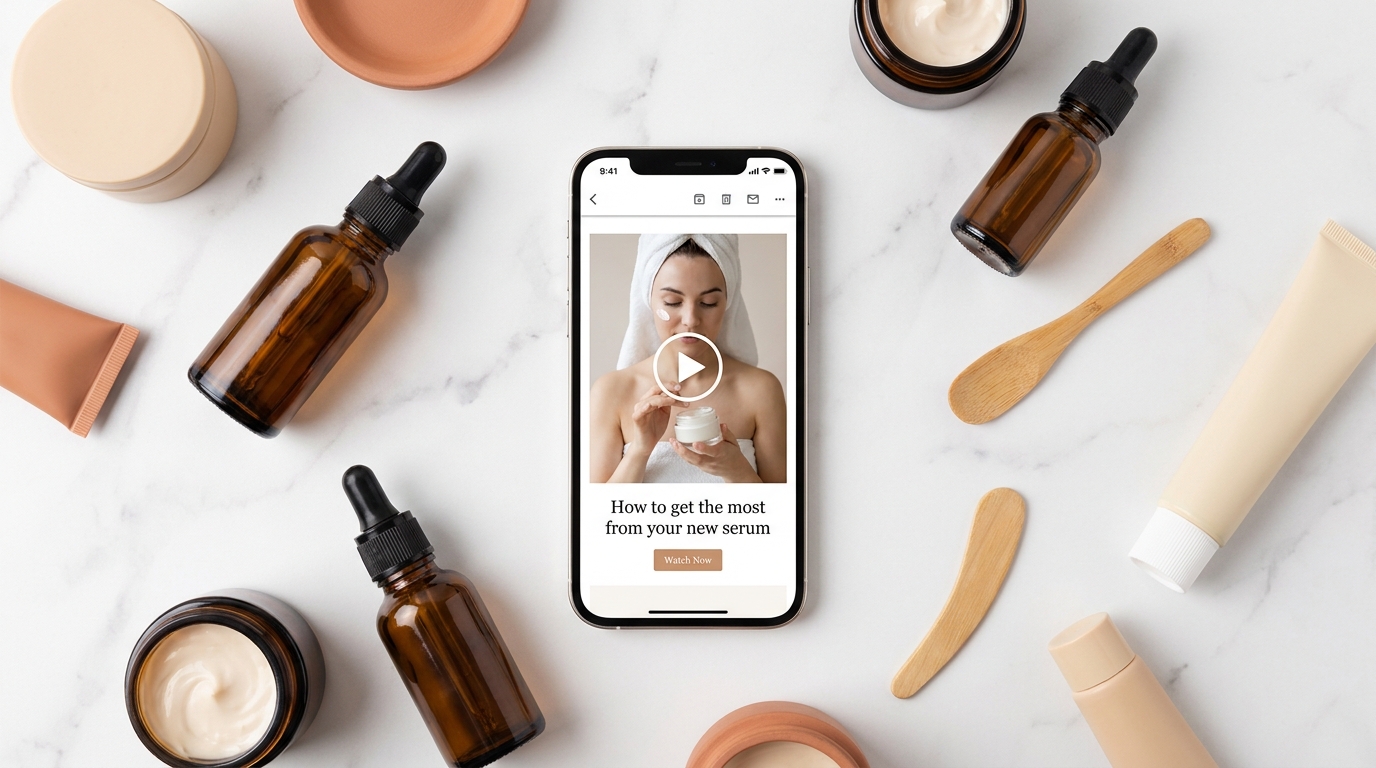
Day 21 to 30 (discovery window): Introduce complementary products through creator video. A customer who bought a serum gets an email featuring a creator's skincare routine that includes the moisturiser and face oil from your range. The video shows the full routine naturally; a product tag or product recommendation block in the email provides the path to purchase. This is how one purchase becomes two.
For a full breakdown of how to build a video-led post-purchase sequence, see our guide to using UGC video to boost Shopify sales.
Strategy 2: Add Video to Your Retention and Win-Back Campaigns
Beyond the initial post-purchase window, video significantly improves performance in the retention email sequences that determine whether lapsed customers return.
Browse abandonment with video social proof. A customer who visits a product page and leaves without buying is in consideration mode. A browse abandonment email that includes a video testimonial for the product they viewed resolves the hesitation that prevented conversion. The same video that converts new visitors on the product page converts lapsed customers in email.
Win-back sequences for customers who have not ordered in 90 days. The 90-day mark is a critical threshold. According to 2026 repeat purchase rate research, brands that do not generate a second purchase within 90 days from a meaningful share of first-time buyers are effectively running at a structural loss. A win-back email featuring new video content, showing recent customer stories and new products, gives lapsed customers a reason to re-engage that a discount code alone cannot provide.
Seasonal and new product launch emails. Video thumbnails in campaign emails consistently outperform static images on click-through rate. When you launch a new product or seasonal collection, a creator video showing it in context is more compelling than a product photograph. Existing customers who are already familiar with your brand quality are your most receptive audience for new product launches.
Strategy 3: Use Video on Account Pages and Loyalty Touchpoints
Most Shopify stores have bare account pages: order history, saved addresses, and nothing else. This is a missed retention opportunity. A customer who logs in to check their order status is already engaged. A video carousel on the account page showing what is new, what other customers are doing with their recent purchases, or what complementary products pair with their order history turns a transactional visit into a discovery moment.
56% of shoppers become repeat buyers after receiving personalised experiences, according to Rivo's 2026 retention benchmarks. Video that feels personal, showing real customers with real products in real contexts, is a form of personalisation that scales without a personalisation engine.
For brands running loyalty programmes, video content can reinforce the value of the programme itself. A video showing what members do with their points, how they access exclusive content, or what the community looks like gives the loyalty programme a human face that static terms and conditions never can.
Strategy 4: Build a Customer Video Community That Drives Ongoing Engagement
The highest-retention Shopify brands do not just collect video content. They build communities around it. Customers who create content about a brand are the most retained customers that brand has, because the act of creating and sharing content deepens the identity connection between the customer and the product.
Mockingbird, a stroller brand, has 140+ parent ambassadors who share authentic video content. Those parents are not just customers; they are advocates whose repeat purchase rate is significantly higher than the brand average because their relationship with the product goes beyond a transaction.
Oru Kayak has 270+ community members and 530+ pieces of content. Vibe Kayaks has 80+ members generating customer adventure video continuously. These brands have built retention infrastructure through community content, and the retention benefit compounds over time as the library grows and the community deepens.
The practical path to building this for a Shopify store without a large team is to start with the content that already exists. Import existing TikTok and Instagram content from customers who have already posted about your products. Use Import by Profile Mentions to find posts tagging your brand handle. Activate Social Sync to automatically import new content every 24 hours. Then use Moast Collect to run structured campaigns with vetted UGC creators, building a pipeline of fresh content that keeps your library growing without ongoing manual effort.
Strategy 5: Use Video to Reduce Return Rates and Protect the Repurchase Cycle
Returns are one of the most underappreciated destroyers of repeat purchase rate. According to Bambuser's 2026 ecommerce retention data, customers who return a product are 50 to 80% less likely to make a second purchase. A 10-point reduction in return rate can lift three-year customer lifetime value by 30 to 50%.
Video reduces returns by setting accurate expectations before purchase and by helping customers succeed with the product after purchase. A product page with authentic customer video showing the product in real use, on real body types, in real lighting, sets expectations that a studio photograph cannot. When a customer buys knowing what they are getting, they are less likely to return it.
Post-purchase video content that helps customers use the product correctly reduces the specific type of return driven by product complexity or setup difficulty. A customer who knows how to use the product properly is a customer who gets the expected result and comes back to buy again.
For brands in categories with high return rates, apparel, beauty, and consumer electronics, video is one of the most direct investments available for protecting repeat purchase rate. For a deeper look at how placement and product tagging work in this context, see our guide to increasing Shopify PDP revenue with shoppable video.

How to Measure Video's Impact on Repeat Purchase Rate
Measuring video's contribution to repeat purchase rate requires tracking a slightly different set of metrics than conversion rate optimisation.
Repeat purchase rate by acquisition cohort. Track whether customers acquired through channels that include video content, paid social with UGC creative, product pages with shoppable video, have higher 90-day and 180-day repeat purchase rates than customers acquired through non-video channels. A meaningful difference indicates that video is building stronger initial purchase conviction, which is a leading indicator of repeat purchase.
Email click-through rate on video vs static. In your post-purchase and retention email sequences, A/B test video thumbnails against static images. Track click-through rate and downstream repeat purchase rate for each variant. This directly measures the impact of video on the email-driven retention channel.
Return rate on pages with video. Compare return rates for products that have shoppable video on their product pages against products that do not. A lower return rate on video-covered pages confirms that video is setting accurate expectations and reducing the return-driven disruption of the repurchase cycle.
Revenue per visitor on repeat sessions. Track revenue per visitor separately for first-time versus returning visitors on pages with video. A higher RPV for returning visitors on video pages confirms that video content is increasing engagement and purchase intent among customers who are already familiar with your brand.
Time between first and second purchase. Monitor whether the introduction of post-purchase video sequences shortens the average time between first and second purchase. A measurable reduction in this interval, even by a few days, has a significant compounding effect on annual repeat purchase rate and customer lifetime value.
Real Brand Results That Show the Retention Impact of Video
ENDU: 38,000 euros more per month from the same customer base.
ENDU, a European fitness brand, added shoppable video reviews to their product pages and saw monthly revenue increase from 307,000 euros to 345,000 euros with identical visitor numbers. That lift reflects both improved conversion from new visitors and higher repeat purchase rates from existing customers who engaged with the video content on return visits.
Dame: 17% conversion lift plus ongoing revenue per visitor improvement.
Dame's $26,000 monthly revenue increase after adding shoppable video breaks down into both new visitor conversion and returning customer engagement. The $0.16 revenue per visitor improvement captures the combined effect of both, including the contribution of existing customers who returned to buy again after engaging with video content.
Vibe Kayaks: A self-sustaining community that generates repeat purchases continuously.
Vibe Kayaks built a community of 80+ customer contributors generating 230+ pieces of content. Their existing customers produce the content that keeps other existing customers engaged. The community creates a retention flywheel: content brings customers back, returning customers create more content, that content keeps more customers coming back.
Mockingbird: 500+ pieces of customer content driving ongoing advocacy and repeat purchase.
Mockingbird's 140+ parent community generates video content that serves both acquisition and retention. Existing customers who create content are the brand's most retained segment. The content they create keeps other existing customers engaged between purchases.
For more examples of how brands have built video strategies that drive measurable revenue, see shoppable video examples: 10 Shopify brands doing it right.
Frequently Asked Questions
What is a good repeat purchase rate for a Shopify store?
The average ecommerce repeat purchase rate is 28.2%, with Shopify stores averaging around 27%. A rate above 30% puts you ahead of the market average. Top-quartile performers reach 40 to 60%, though benchmarks vary significantly by category. Beauty and personal care averages 2.4 purchases per customer per year; DTC food and beverage leads at approximately 3.8 purchases per year; home and furniture sits lower at 1.4.
How does video increase repeat purchase rate on Shopify?
Video increases repeat purchase rate through four mechanisms: post-purchase confidence (customers who succeed with their purchase return for more), product range discovery (creator content showing multiple products drives second purchases), community reinforcement (customer video content deepens brand identity and loyalty), and improved email performance (video in retention sequences outperforms static imagery on click-through and conversion).
Where should I use video in my Shopify retention strategy?
The highest-impact placements for video in a retention strategy are post-purchase email sequences (days 1 to 30 after first purchase), win-back campaigns for customers lapsed more than 90 days, account pages where engaged customers log in between purchases, and product pages where returning customers are considering their next purchase. Each placement works through a different retention mechanism.
How do I get customer video content for my retention strategy?
Start by importing existing TikTok and Instagram content from customers who have already posted about your products. Use Import by Profile Mentions in Moast to surface every post tagging your brand handle, then activate Social Sync to automatically import new content every 24 hours. For a structured ongoing pipeline, Moast Collect connects your store to a network of vetted UGC creators who produce short product videos in exchange for gifted product, with no cash payout required.
How does video reduce return rates on Shopify?
Authentic customer video on product pages sets accurate expectations by showing the product in real use, on real people, in real conditions. Customers who buy knowing what they are getting return products at lower rates. Post-purchase tutorial and how-to video reduces returns driven by product complexity. Customers who return a product are 50 to 80% less likely to make a second purchase, so every return prevented is a repeat purchase protected.
Get started with Moast for free
Related reading: How to increase Shopify average order value with video · How to collect customer video testimonials without asking twice · How to build a video commerce strategy for Shopify
September 1, 2026
Related content
.jpg)
.jpg)
.jpg)
Turn your social content into a revenue channel
Turn your TikToks and Reels into shoppable videos and boost conversions by 3.5x.