
- Why AOV Is the Most Underrated Revenue Lever in Ecommerce
- How Video Specifically Increases Average Order Value
- Strategy 1: Use Video to Showcase Product Bundles and Sets
- Strategy 2: Surface Complementary Products Through Creator Content
- Strategy 3: Use Video to Justify Premium Pricing
- Strategy 4: Show the Full Product Range
- Strategy 5: Use Video on Collection Pages
- Strategy 6: Deploy Video Above Free Shipping Thresholds
- The Compounding Effect: AOV and Conversion Rate Together
- Real Brand Results With Measurable Revenue Impact
- How to Measure Video's Impact on Your AOV
- Frequently Asked Questions
Most Shopify brands focus on getting more traffic or converting more of it. There's a third lever that gets far less attention — getting every order to be worth more. Video is one of the most effective tools for moving it.
Why AOV Is the Most Underrated Revenue Lever in Ecommerce
According to ClickPost's ecommerce AOV benchmarks, the global ecommerce average order value sits at $150 as of late 2025, with desktop shoppers ordering $192 on average versus $133 on mobile. Ringly.io's 2026 AOV statistics show bundles lift AOV 20 to 35% on average, with best-in-class implementations reaching 55%, and repeat customers spending 4.8x more than first-time buyers.
These numbers point to a straightforward opportunity: a small increase in AOV produces a significant increase in revenue without requiring a single additional visitor, a larger ad budget, or a higher conversion rate.
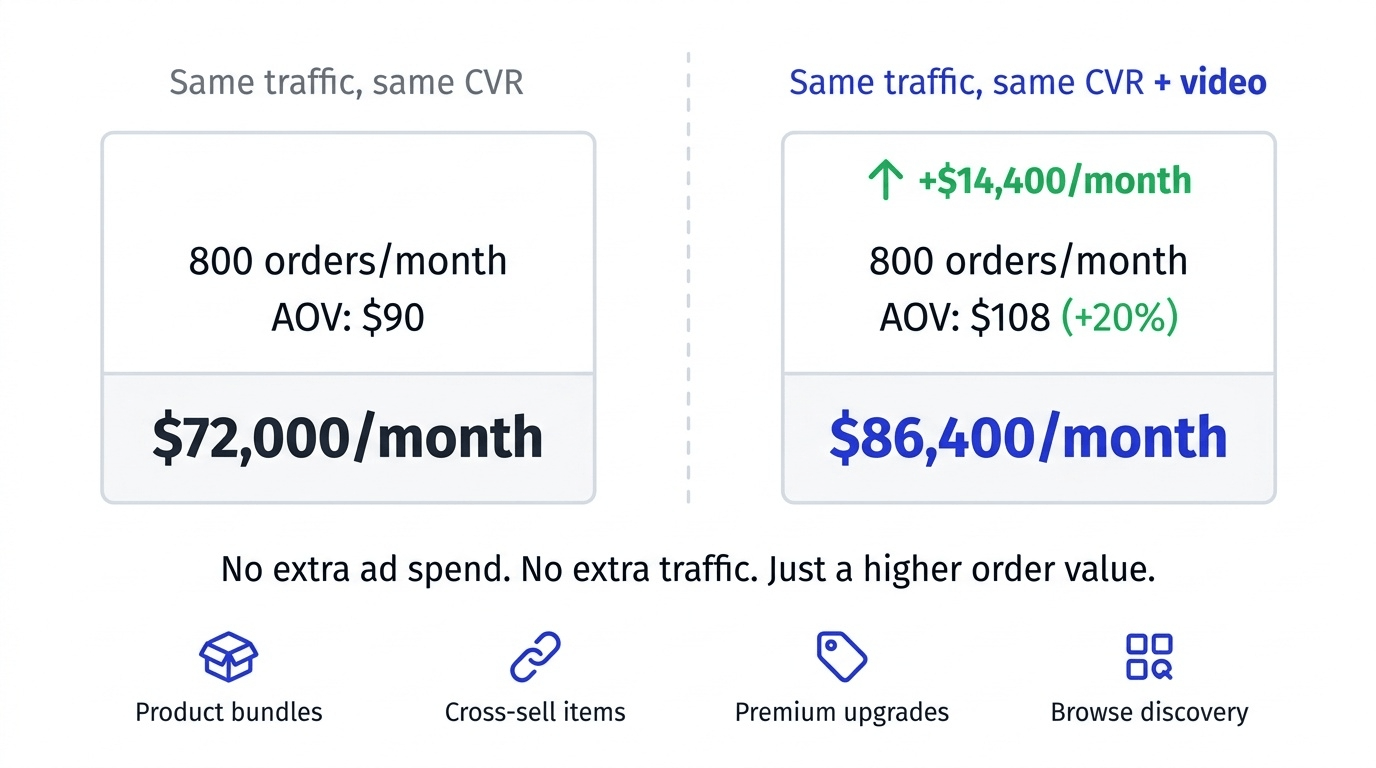
The arithmetic is stark. As Shopify's own AOV guide explains, AOV is one of the first numbers brands should improve to increase revenue without additional ad spend. If your store generates 800 orders per month at an AOV of $90, your monthly revenue is $72,000. Increase AOV by 20% to $108 and — with everything else held constant — monthly revenue becomes $86,400. That's $14,400 more per month from the same traffic, the same conversion rate, and the same marketing spend.
As Kard's ecommerce research confirms, every dollar added to AOV translates to higher revenue per session, greater profit margins, and improved campaign efficiency without driving more traffic or increasing ad spend. Yet most Shopify brands spend the overwhelming majority of their optimisation effort on conversion rate and traffic acquisition, leaving AOV largely untouched.
Video is one of the most direct and underused tools for moving AOV. Not because video is inherently persuasive — it is — but because of the specific mechanisms through which video changes how shoppers discover, evaluate, and ultimately buy. This post covers six specific strategies for using video to increase average order value on Shopify, with the data and real-world examples behind each.
How Video Specifically Increases Average Order Value
Before getting into tactics, it's worth understanding the mechanisms through which video affects AOV. Unlike conversion rate optimisation, which is about getting more people to buy, AOV optimisation is about getting the people who do buy to add more to their carts.
Video influences AOV through four distinct mechanisms:
- Discovery of related products. A customer who arrived at a product page for one item and sees a creator styling it alongside two complementary pieces discovers products they didn't come looking for. Each discovery is a potential additional line item in the cart.
- Confidence in premium pricing. A shopper weighing a lower-priced version against a premium version of the same product type is more likely to choose the premium option after watching a video that shows the quality difference in real use. Video justifies price premiums in a way that static descriptions and photography cannot.
- Bundle visualisation. A video showing a product used as part of a set makes the bundle feel more natural and desirable than a text widget on the product page. When shoppers can see the full picture, they're more likely to buy it.
- Extended browsing time. Shoppers spend 2x more time on product pages with video compared to static image pages. More time on page means more time to discover additional products, read more about the range, and build a larger consideration set before checking out.
Strategy 1: Use Video to Showcase Product Bundles and Sets
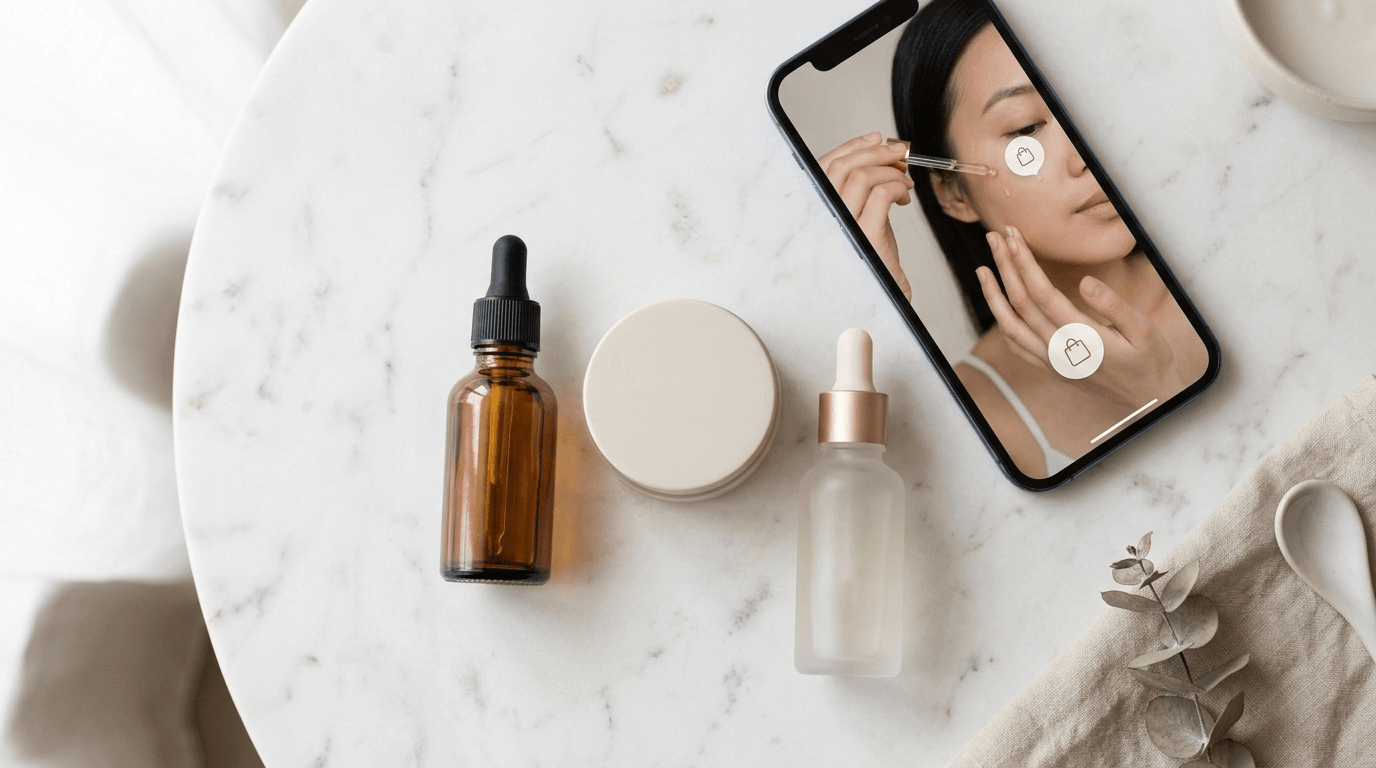
The most direct video AOV lever is bundle visualisation. A video that shows two or three products being used together — a skincare routine, a matching outfit, a coffee setup — makes the bundle feel like a natural single purchase rather than an upsell.
The key is that the bundle demonstration should feel authentic, not promotional. A creator doing their morning skincare routine and using three of your products in sequence is more persuasive than a brand-produced "buy the set" ad. The former shows how the products work together in real life; the latter reads as marketing.
How to implement: Import creator or customer content that naturally features multiple products from your range together. Tag every product that appears in the video. When a shopper watches the video and sees the routine or the set, every item has a product tag they can tap directly. Instead of one add-to-cart, you can generate two or three from a single video view.
This is also one of the most effective arguments for tagging multiple products in every video rather than just the primary product on the page. A video on a moisturiser product page that also tags the serum and the cleanser shown in the same routine is performing AOV optimisation every time it's watched — without any additional work after the initial tagging.
Strategy 2: Surface Complementary Products Through Creator Content
Creator content is uniquely effective at surfacing complementary products because it mirrors how real customers actually shop. A creator who wears your jacket and mentions that they pair it with your bag, or a customer who shows how they use your protein powder alongside your shaker, is providing styling and pairing advice that feels like a recommendation from a friend rather than an upsell from a retailer.
This matters for AOV because UGC video generates significantly more trust than branded content, and trust is what makes a shopper willing to add an item they hadn't planned to buy. A "you might also like" widget on the product page is ignored by most shoppers. The same complementary product, shown in use by a real person they've just watched for 30 seconds, is a different proposition entirely.
How to implement: When importing creator content, actively look for videos that feature product combinations. If a creator has filmed a tutorial showing multiple items from your range, that video is more valuable for AOV than a video featuring a single product in isolation. Import it, tag every product shown, and place it on the product page for the hero item in the video. Shoppers who land on that page via the primary product will discover the complementary items through the video.
For apparel brands, this is how LNDR approaches their product page video strategy: every PDP shows the product three ways, including how it's worn and styled alongside other pieces. The multi-product visibility from a single page view directly contributes to multi-product orders.
Ps. try using Moast Collect to acquire free UGC from customers.
Strategy 3: Use Video to Justify Premium Pricing
One of the most consistent findings in ecommerce pricing research is that shoppers anchor on the cheapest option in a category unless given a compelling reason to pay more. That reason is almost always about perceived quality — and quality is one of the hardest things to communicate through a product page without video.
A high-quality jacket photographed in a studio looks similar to a lower-quality jacket photographed in a studio. The same two jackets handled, worn, and described by a real customer over 30 seconds reveal quality differences that the photographs never could: the weight of the fabric, the quality of the zip, the way the collar sits, the fit across the shoulders.
Video justifies premium pricing by making quality tangible. And tangible quality perception directly increases AOV, because shoppers who buy the premium version spend more per order than shoppers who buy the entry-level option.
Companies implementing comprehensive AOV optimisation strategies are seeing 15 to 30% increases through better customer experience and premium positioning. Video is the mechanism through which premium positioning becomes legible to a shopper who can't touch the product.
How to implement: Prioritise video content that shows product quality in real use — materials, construction, performance under realistic conditions. Place this content near the product variant selector on your PDPs, where shoppers are actively choosing between price points. A video that shows the premium version being used authentically at the moment a shopper is deciding between options is one of the highest-value placements in your store.
Strategy 4: Show the Full Product Range, Not Just the Item Being Viewed
Most product pages show a product in isolation. Video gives you the ability to expand a shopper's awareness of your full range without requiring them to navigate away from the page they landed on.
A customer who arrives on a product page via a specific search is, by definition, looking for that product. But a customer who watches a creator video that incidentally shows three other products from your range becomes aware of items they didn't know to search for. That awareness, combined with the convenience of product tags that let them tap straight through to any item shown, creates multi-product discovery within a single page visit.
This is closely related to what shoppable video examples from brands like American Candy Store demonstrate: haul content and multi-product videos tagged comprehensively create browsing patterns that generate larger baskets than single-product pages ever could.
How to implement: When building your video library, treat multi-product creator content as a distinct and particularly valuable asset type. A haul video featuring ten products from your range, fully tagged, is doing more AOV work per view than ten individual product videos. Prioritise this content type in your import and collection strategy, and place it prominently on your most-visited product pages.
Strategy 5: Use Video on Collection Pages to Drive Multi-Product Discovery
Most collection page video is an afterthought. The standard Shopify collection page is a grid of product images with names and prices — functional, but not designed to inspire the kind of browsing that leads to multi-product orders.
A video carousel on a collection page changes the dynamic. Instead of a grid of static options that shoppers scan and filter, a carousel of customer and creator videos showing items from the collection in real use turns a transactional browsing experience into something closer to a showroom or a social feed. Shoppers linger, discover items they didn't notice in the grid, and build consideration sets that span multiple products.
Desktop shoppers have a significantly higher AOV than mobile shoppers ($192 vs $133), in part because the browsing experience on desktop lends itself more to multi-product discovery. Video on collection pages partially closes that gap on mobile by creating the same kind of immersive, discovery-oriented browsing experience that drives larger baskets on desktop.
How to implement: Add a Moast video carousel to your highest-traffic collection pages, populated with content that features multiple products from the collection. Tag every product shown in every video. Review the analytics after four weeks: look for changes in items per order and average order value on sessions that included a collection page visit with video engagement.
Strategy 6: Deploy Video Above Free Shipping Thresholds
Free shipping thresholds are one of the most established AOV levers in ecommerce. Setting a free shipping threshold above your current AOV gives shoppers a concrete incentive to add more to their cart before checking out. The challenge is giving them something to add.
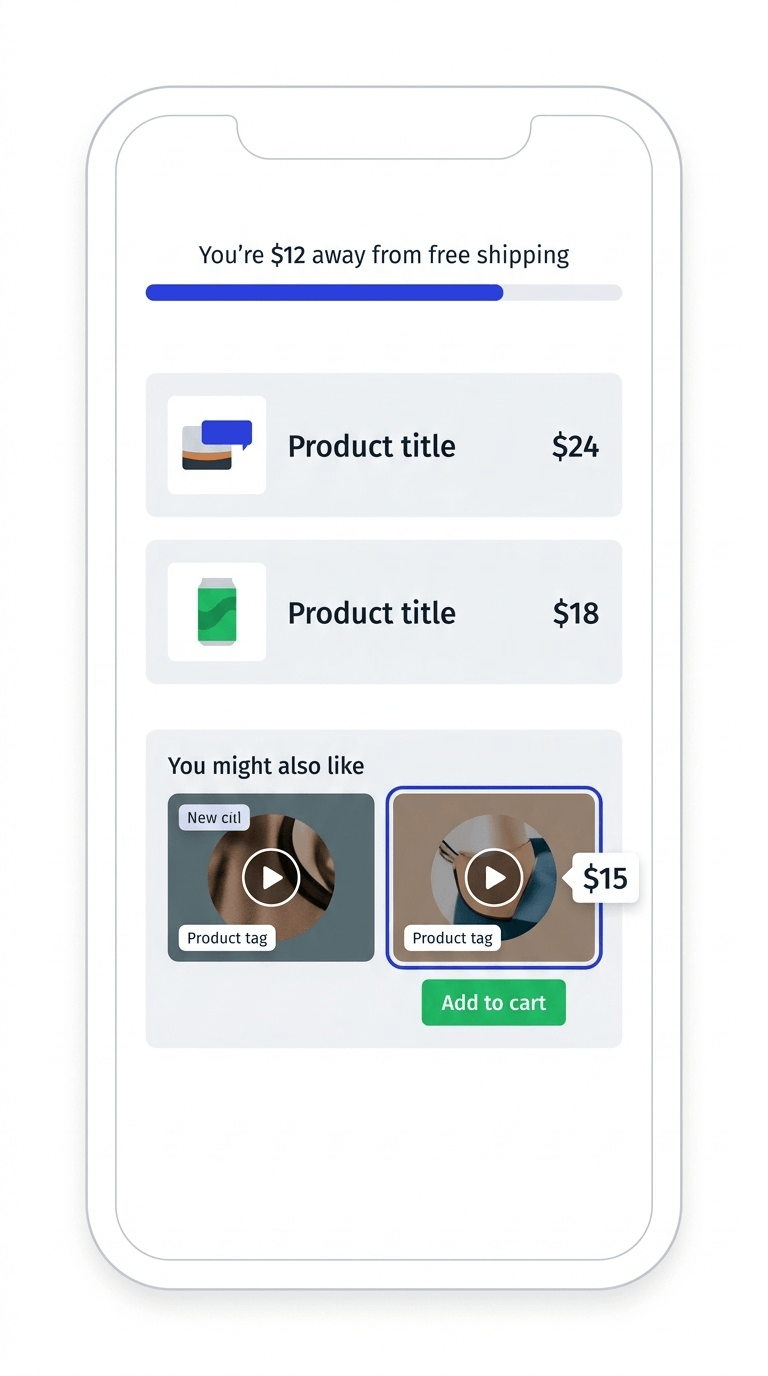
This is where video becomes a direct AOV tool. A shopper who is £12 below the free shipping threshold and sees a video featuring a product that costs £15 is likely to add it. The video provides the discovery; the threshold provides the motivation; the product tag provides the frictionless path to adding it.
Combining a free shipping threshold bar with a video carousel featuring complementary or accessory products creates one of the highest-impact AOV setups available on Shopify. The threshold creates the intent to add more; the video provides the inspiration for what to add; the product tag removes the friction of searching.
How to implement: Identify your most common accessory or add-on products — items that pair naturally with best-sellers and sit at a price point that would take most shoppers over your free shipping threshold. Create or import video content featuring these items being used alongside the hero products in your range. Place a small featured video or stories widget near the free shipping threshold progress bar on cart pages, or use a floating video bubble on product pages that surfaces this complementary content throughout the browsing session.
For a more detailed look at how placement affects conversion outcomes, see our guide to increasing Shopify PDP revenue with shoppable video.
The Compounding Effect: AOV and Conversion Rate Together
The strategies above primarily target AOV, but most of them produce a secondary benefit: they also improve conversion rate. Video above the reviews section converts more visitors to buyers; video on collection pages increases time on site and reduces bounce rate; video that justifies premium pricing reduces return rates.
This compounding effect is what makes video one of the highest-ROI investments available to Shopify brands. Consider what happens when you improve both metrics simultaneously:
- Store with 50,000 monthly sessions, 1.5% CVR, $90 AOV: $67,500/month
- Same store with 1.76% CVR (+17%) and $99 AOV (+10%): $87,120/month
That's $19,620 more per month — a 29% revenue increase — from a single infrastructure investment that runs without ongoing cost. The conversion rate lift comes from shoppable video on PDPs; the AOV lift comes from multi-product tagging, bundle visualisation, and premium positioning through video.
The brands generating the most measurable results from shoppable video are the ones tracking both metrics. If you're only watching conversion rate, you're missing half the return.
Real Brand Results With Measurable Revenue Impact
Dame — $0.16 more in revenue per visitor from the same traffic. Dame's $26,000 monthly revenue increase after adding shoppable video breaks down into both a conversion rate lift (17%) and a revenue per visitor improvement ($0.16). RPV captures the combined effect of more visitors buying and each order being worth more. The RPV metric is the clearest signal that video is affecting both conversion and order value simultaneously.
ENDU — €38,000 more per month from 100,000 visitors. ENDU, a European fitness brand, saw monthly revenue increase from €307,000 to €345,000 after adding shoppable video reviews to their product pages — with the same traffic. That €38,000 lift reflects both improved conversion and larger average orders from shoppers who watched video content that expanded their awareness of the product range.
ThruDark — $5,854 in attributable sales in 30 days. ThruDark's results from placing a shoppable video carousel above the reviews section on their premium performance apparel PDPs demonstrate how video can shift purchasing toward higher-value items. Their products are premium-priced and technically complex — exactly the context where video justification of price points has the greatest impact on order value.
For more examples of how brands have built video strategies that move revenue, see shoppable video examples: 10 Shopify brands doing it right.
How to Measure Video's Impact on Your AOV
Measuring video's impact on AOV specifically — rather than just conversion rate — requires tracking a slightly different set of metrics.
- Revenue per visitor (RPV). The cleanest single metric for measuring the combined impact of video on both conversion rate and order value. RPV = total revenue divided by total sessions. An increase in RPV captures both more people buying and each order being worth more. Dame's $0.16 RPV improvement is a benchmark for what meaningful video-driven AOV improvement looks like.
- Items per order on video-engaged sessions. Compare the average number of items per order for sessions where a shopper engaged with a video widget versus sessions where they didn't. A meaningful difference indicates that video is driving multi-product discovery and multi-product purchasing.
- Product tag click-through by product type. In your Moast analytics, review which product tags in which videos are generating the most clicks. Tags on complementary and accessory products appearing in multi-product videos are your highest-value AOV drivers — identify them and prioritise building more content of that type.
- Variant upgrade rate on product pages with video. On product pages where you offer multiple price points or quality tiers, track whether shoppers who watch a video are more likely to choose the premium variant. A positive correlation confirms that video is justifying premium pricing and driving AOV upward through variant selection.
Review these metrics monthly. The AOV impact of video tends to build over time as your library grows, more products get tagged, and more pages have video coverage — so the picture at month three is meaningfully better than the picture at week one.
Frequently Asked Questions
How does video increase average order value on Shopify?
Video increases AOV through four mechanisms: it drives discovery of related and complementary products through multi-product creator content with tagged items; it justifies premium pricing by making quality differences tangible in real use; it makes bundles feel natural and desirable rather than promotional; and it extends time on page, giving shoppers more opportunity to discover additional products before checking out.
Which type of video is most effective for increasing AOV?
Multi-product creator and customer content — videos that naturally feature several items from your range being used together — is the most effective video type for AOV. Every product shown can be tagged, creating multiple simultaneous discovery and purchase pathways from a single video view. Haul content, routine videos, and lifestyle content that shows products in combination consistently outperform single-product demo videos for AOV impact.
Where should I place video on Shopify to maximise AOV?
For AOV specifically, the highest-impact placements are on collection pages (where multi-product discovery happens during browsing) and near free shipping threshold indicators (where shoppers have an active incentive to add more to their cart). For the combined impact on both conversion rate and AOV, above the reviews section on PDPs remains the highest-converting position overall.
How do product tags in shoppable video affect AOV?
Product tags are what convert video-driven discovery into actual AOV lift. Without tags, a multi-product video builds awareness but requires shoppers to manually search for and find the items they've just seen — most won't. With tags, a single tap takes them directly to the product page or add-to-cart flow. Tagging every product visible in every video is the single most important technical practice for AOV optimisation through shoppable video.
How do I measure video's impact on average order value?
Track revenue per visitor (RPV) before and after adding video to your product pages — it captures both conversion rate and AOV changes in a single metric. Also track items per order for sessions with video engagement versus sessions without, and monitor product tag click-through rates on complementary products to understand which content is driving multi-product purchasing.
Can shoppable video increase AOV without hurting conversion rate?
Yes — and in practice, the strategies that increase AOV through video tend to also improve conversion rate, because the content that makes shoppers buy more is also the content that resolves purchase hesitation. Multi-product videos with tagged items, premium product demonstrations, and bundle visualisation all increase the confidence and inspiration that lead to both higher conversion and larger orders.
AOV is the revenue lever that most Shopify brands leave largely untouched. Traffic optimisation and conversion rate work are harder and more expensive than they used to be. Getting more value from the orders you're already generating — by helping shoppers discover complementary products, choose premium options, and see how your range works together — is both more efficient and more sustainable.
Video is the mechanism that makes all of it possible. The same authentic creator content that converts more visitors also shows them more products, justifies more value, and builds baskets that are meaningfully larger than what a static product page ever could.
Get started with Moast for free
Related reading: How to increase Shopify conversion rate with video: a complete guide · How to use UGC video to boost Shopify sales · Shoppable video examples: 10 Shopify brands doing it right
Related content
.jpg)
.jpg)
Turn your social content into a revenue channel
Turn your TikToks and Reels into shoppable videos and boost conversions by 3.5x.