
- How shoppable video apps charge — the three billing models
- What you get on a free plan
- Flat-tier pricing: what to expect at each level
- View-based pricing: the hidden cost problem
- What Moast costs in 2026
- The true cost of shoppable video: ROI vs monthly fee
- What to look for beyond the price tag
- Frequently asked questions
Shoppable video apps for Shopify range from free to over $300 per month. The price you pay matters far less than understanding what each pricing model actually costs you as your store grows. Here is the complete 2026 breakdown.

How Shoppable Video Apps Charge — The Three Billing Models
Before comparing specific prices, it is worth understanding that shoppable video apps use three fundamentally different billing models. The model matters more than the headline price, because the wrong model can cost you significantly more than expected as your traffic grows.
Free plans with feature limits. Most shoppable video apps offer a free tier. The limitations vary: some cap the number of videos you can publish, others restrict which widget types are available, and some remove product tagging entirely on the free plan. Free plans are a legitimate starting point for stores with low traffic and limited video content, but they are designed to convert you to paid as your usage grows.
Flat-tier pricing. A fixed monthly fee that unlocks a specific set of features regardless of how many views your videos receive. This is the model that scales best for growing Shopify stores, because your app cost stays predictable even as your traffic increases. Moast, Storista, Tolstoy, SwipeUp, Reelfy, and Videowise all use flat-tier pricing at some level.
View-based pricing. A model where you pay based on how many times your videos are watched or clicked. The entry price looks low, but the bill rises directly with your traffic. According to Libautech's 2026 shoppable video price comparison, ReelUp's free plan allows only 100 views per month, and 50,000 monthly views costs $199.99. Quinn and Whatmore use similar models. For stores with significant traffic, view-based pricing can become one of the most expensive options in the category despite the low entry point.
What You Get on a Free Plan
Free plans are real, but they come with meaningful limitations that matter for conversion performance. Understanding what is and is not included is essential before committing to a free tier as a long-term strategy.
What most free plans include: basic video embedding, a limited number of videos (typically 3 to 10), and access to one widget type. Some free plans include product tagging; many do not.
What most free plans exclude: unlimited video publishing, multiple widget types, social import from TikTok and Instagram, analytics beyond basic view counts, and revenue attribution. The features excluded from free plans are precisely the features that drive conversion rate improvement — product tagging, social import, and revenue analytics are what separate a decorative video embed from a shoppable commerce tool.
Moast's free plan includes product tagging, TikTok and Instagram import, the stories widget, and basic analytics. It is one of the most generous free tiers in the category because the core conversion mechanism — a tagged, shoppable video on a product page — is fully available without a paid subscription. For stores just getting started with shoppable video, the free plan is a complete starting point, not a stripped-down preview.
Flat-Tier Pricing: What to Expect at Each Level
For the majority of Shopify brands, flat-tier pricing is the right model. Here is what the market looks like at each price point in 2026.
Under $20/month: Entry-level paid plans from most major apps. At this tier you typically get unlimited video publishing, multiple widget types, social import, and basic analytics. Moast's Pro plan is $15/month and includes everything in the free plan plus unlimited videos, all widget types, Social Sync for automatic TikTok and Instagram imports, and full revenue attribution analytics.
$20 to $50/month: Mid-tier plans that typically add priority support, advanced customisation, A/B testing, and higher-tier analytics. Storista operates in this range. For most independent Shopify brands, the features added at this tier are incremental rather than transformative relative to the entry paid tier.
$50 to $150/month: Upper mid-tier plans typically aimed at larger stores with high traffic volume, multiple team members, and advanced analytics requirements. Tolstoy's plans reach this range. Videowise starts around $126/month for approximately 50,000 monthly visitors according to Join Stories' 2026 platform comparison.
$150 to $300+/month: Enterprise plans from platforms like Videowise and Tolstoy. At this tier you are typically paying for dedicated support, custom integrations, live shopping features, and enterprise-level analytics. For most Shopify brands under $5 million in annual revenue, the ROI case for enterprise shoppable video pricing is difficult to justify when flat-tier plans at $15 to $50/month produce equivalent conversion outcomes on product pages.
View-Based Pricing: The Hidden Cost Problem
View-based pricing deserves specific attention because it is the model most likely to produce unexpected bills. The pattern is consistent: a low or free entry point that looks competitive, followed by costs that scale directly with your traffic rather than with the value you receive.
Consider the math. A Shopify store with 50,000 monthly sessions and a 40% product page engagement rate generates roughly 20,000 video views per month. On ReelUp's view-based model, that volume costs significantly more than a flat-tier app at $15/month that handles the same traffic with no additional charge.
The fundamental problem with view-based pricing is that it penalises success. As your store grows and more visitors watch your shoppable videos — which is the entire point of adding them — your app bill increases. Flat-tier pricing separates your app cost from your traffic volume, which is why it is the better model for scaling Shopify brands.
For a direct comparison of how view-based and flat-tier pricing models compare across specific apps, see our detailed comparison pages: Moast vs ReelUp, Moast vs Quinn, and Moast vs Whatmore.
What Moast Costs in 2026
Moast has three plans in 2026:
Free: Product tagging, TikTok and Instagram URL import, stories widget, basic analytics, up to 10 videos. No credit card required.
Pro ($15/month): Everything in the free plan plus unlimited videos, all widget types (stories, carousel, floating bubble, featured video), Social Sync for automatic 24-hour imports from connected TikTok and Instagram accounts, full revenue attribution analytics, and priority support.
Enterprise: Custom pricing for stores with specific requirements around volume, dedicated support, or custom integrations.
Moast carries the Built for Shopify badge — Shopify's quality mark for apps that meet performance, design, and integration standards.
For how Moast compares specifically against other apps, see our comparison pages: Moast vs Tolstoy, Moast vs Videowise, Moast vs Firework, and Moast vs SwipeUp.
The True Cost of Shoppable Video: ROI vs Monthly Fee
The monthly fee is the wrong metric for evaluating shoppable video cost. The right metric is revenue per visitor on pages with video versus pages without, and the cost of not having it.
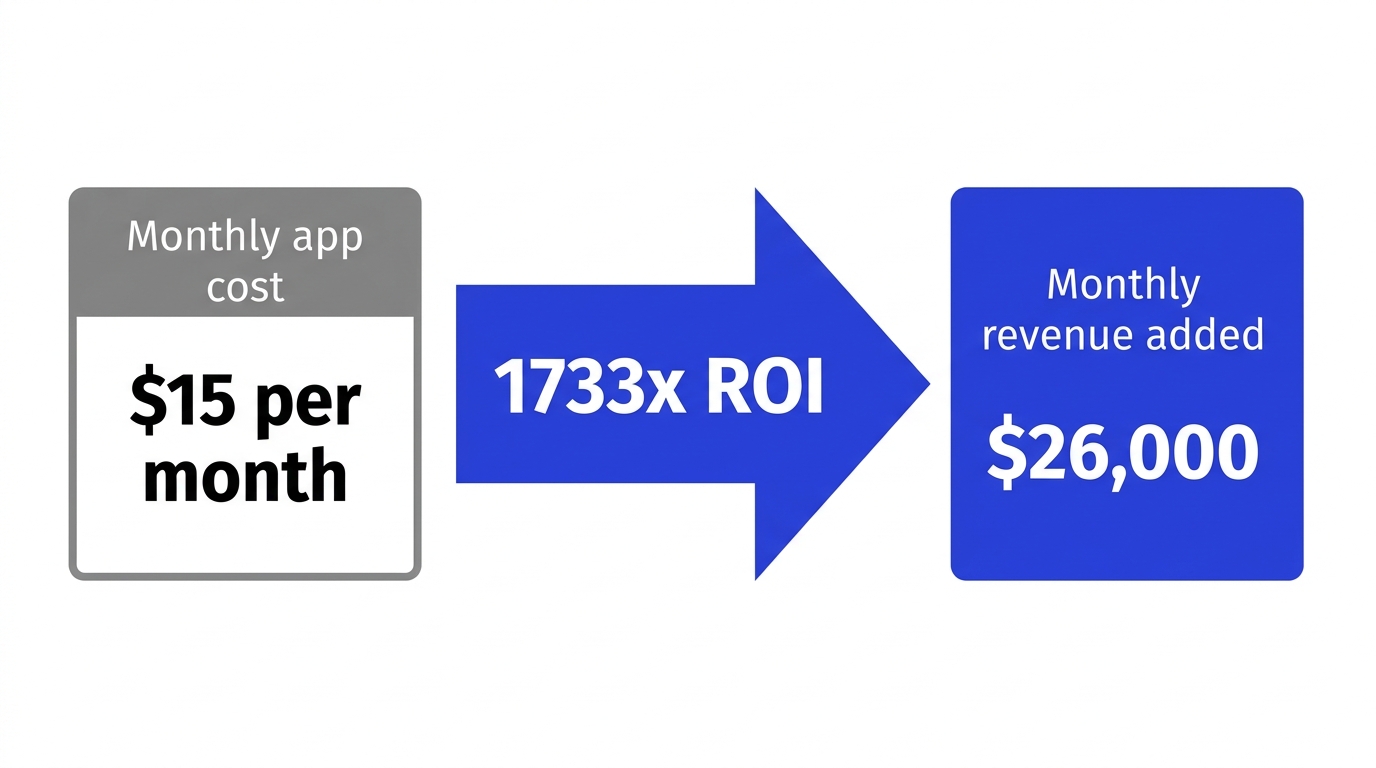
Dame, a wellness brand, added $26,000 in monthly revenue after adding shoppable video to their product pages at a monthly app cost of $15. That is a return of over 1,700x the monthly fee in the first month. ThruDark generated $5,854 in directly attributable sales in 30 days from a shoppable video carousel. ENDU saw monthly revenue increase from 307,000 euros to 345,000 euros with the same traffic after adding shoppable video reviews to their product pages.
These results reflect a consistent pattern: shoppable video on Shopify product pages produces measurable conversion lifts that dwarf the monthly cost of the app producing them. The question for most Shopify brands is not whether shoppable video is worth the monthly fee. It is how much revenue they are leaving on the table each month they do not have it.
For a detailed breakdown of how shoppable video drives revenue across different metrics, see our guide to increasing Shopify PDP revenue with shoppable video.
What to Look for Beyond the Price Tag
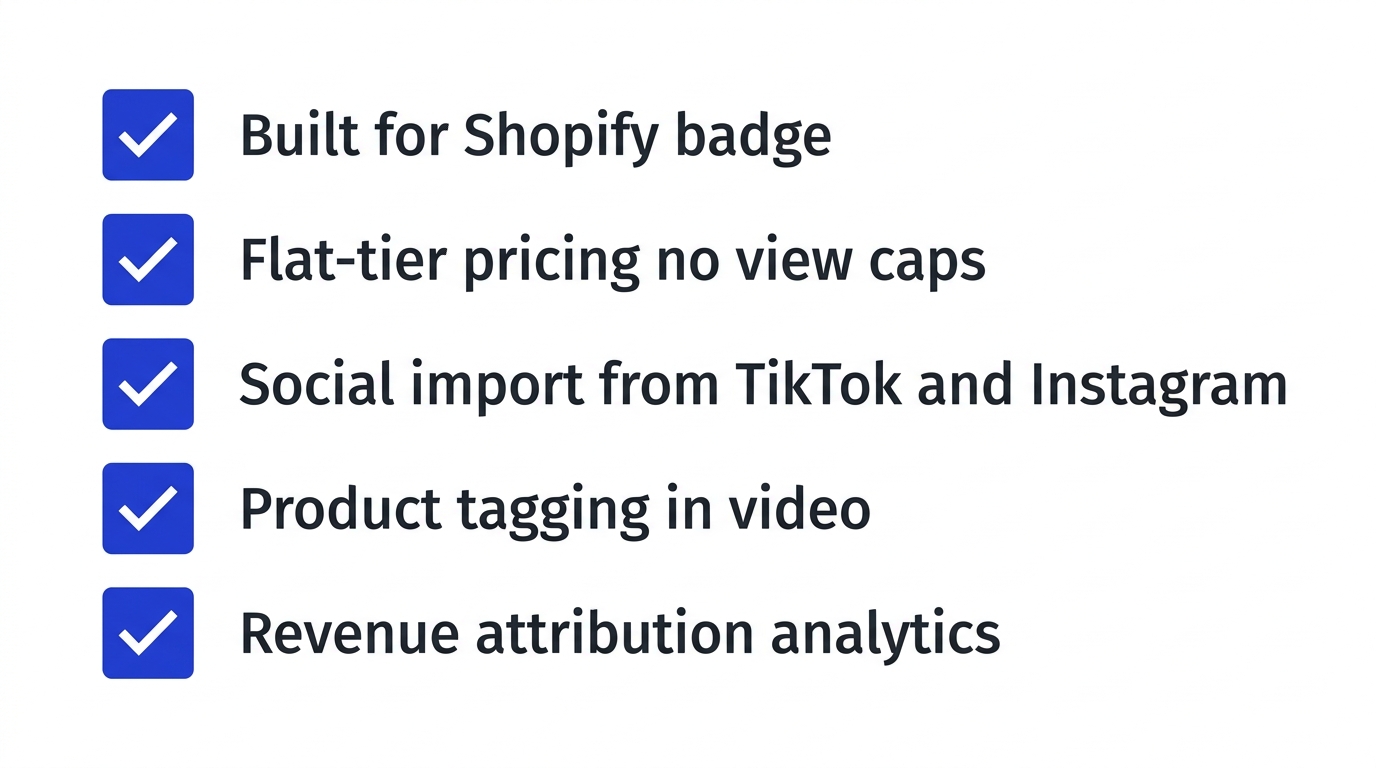
Built for Shopify badge. The badge confirms the app meets Shopify's standards for performance, design, and integration. Apps without it may introduce page speed issues or theme conflicts.
Flat-tier pricing with no view caps. Check the pricing page carefully — some apps advertise a flat monthly fee but add view-based charges above a certain threshold.
Native TikTok and Instagram import. An app that requires manual video uploads is significantly more work to maintain than one that imports directly from TikTok and Instagram by URL or via automatic Social Sync.
Product tagging in video. Without product tags, a video is content, not commerce. Confirm that product tagging is included on the plan you are evaluating, not reserved for a higher tier.
Revenue attribution analytics. An app that reports only views is telling you how many people watched, not how many bought. Revenue attribution is what separates an app that feels like it is working from one you can prove is working.
For a broader view of how to evaluate and implement shoppable video, see our guide to building a video commerce strategy for Shopify.
Frequently Asked Questions
How much does shoppable video cost for Shopify?
Shoppable video apps for Shopify range from free to over $300 per month. Most stores find that a flat-tier plan in the $15 to $50 per month range covers everything they need: unlimited videos, product tagging, social import, and revenue analytics.
Is there a free shoppable video app for Shopify?
Yes. Moast's free plan includes product tagging, TikTok and Instagram import, and the stories widget — the core features needed to add genuinely shoppable video to product pages.
What is the difference between flat-tier and view-based shoppable video pricing?
Flat-tier pricing charges a fixed monthly fee regardless of how many times your videos are watched. View-based pricing charges based on video views or clicks, meaning your bill rises as your traffic grows. For scaling Shopify stores, flat-tier pricing is more predictable and typically more cost-effective.
Does Moast have a free plan?
Yes. Moast's free plan includes product tagging, TikTok and Instagram URL import, the stories widget, and basic analytics for up to 10 videos. No credit card is required. The Pro plan at $15/month adds unlimited videos, all widget types, Social Sync, and full revenue attribution analytics.
Which shoppable video app is best value for Shopify?
For most Shopify brands, Moast offers the strongest value: a genuinely useful free plan, a $15/month Pro plan with unlimited videos and flat-tier pricing, Built for Shopify certification, and native TikTok and Instagram import. See our comparison pages for Tolstoy, Videowise, Firework, Quinn, SwipeUp, ReelUp, and Whatmore.
Get started with Moast for free
Related reading: Shoppable video vs traditional video ads: what converts better on Shopify · How to increase Shopify conversion rate with video · Shoppable video examples: 10 Shopify brands doing it right
August 28, 2026
Related content
.jpg)
.jpg)
.jpg)
Turn your social content into a revenue channel
Turn your TikToks and Reels into shoppable videos and boost conversions by 3.5x.