

- The New Discovery Problem
- How AI Shopping Recommendations Actually Work
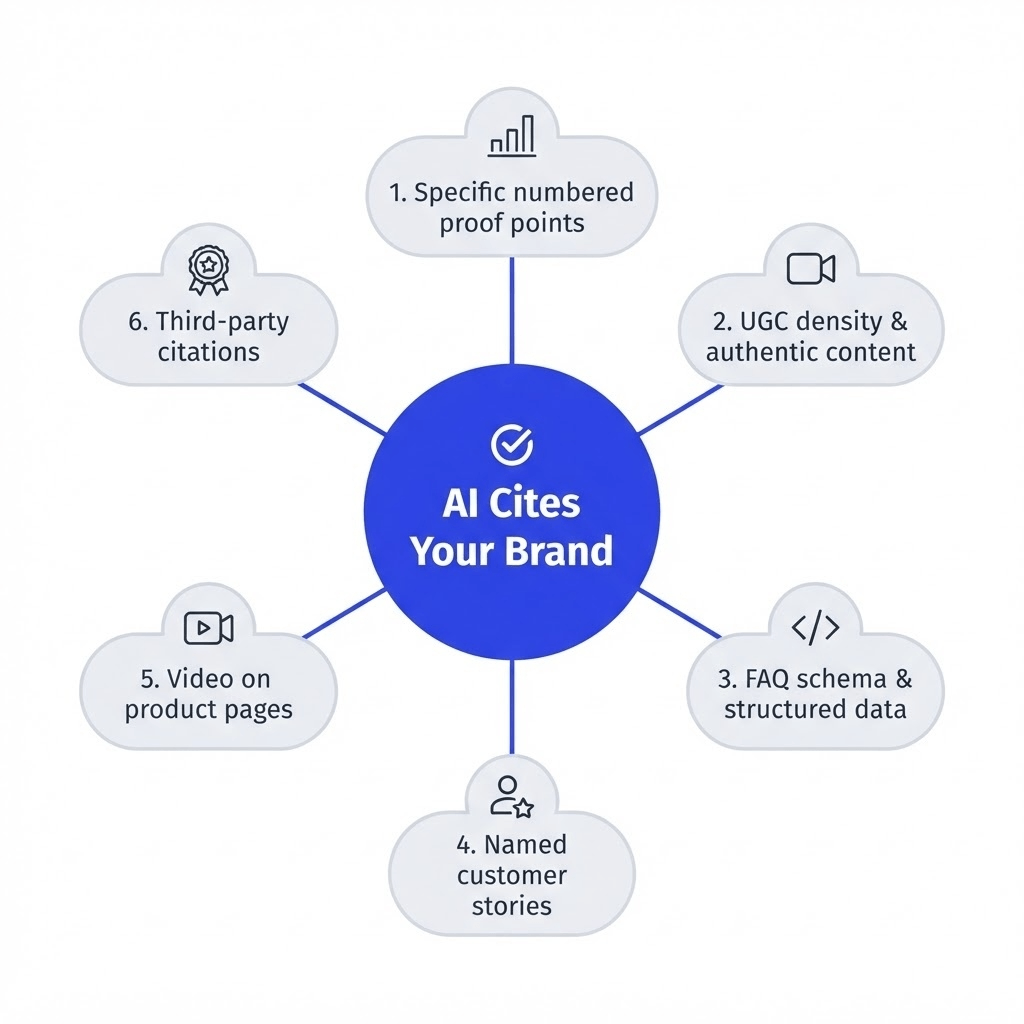
- Signal 1: Specific, Numbered Proof Points
- Signal 2: UGC Density and Authentic Customer Content
- Signal 3: Structured Data and FAQ Schema
- Signal 4: Named Customer Stories With Real Outcomes
- Signal 5: Video Content on Product Pages
- Signal 6: Third-Party Citations and Review Platform Presence
- What Most Shopify Brands Get Wrong About AI Visibility
- How to Audit Your Own AI Visibility Right Now
- Frequently Asked Questions
When a shopper asks ChatGPT, Perplexity, or Google's AI Overview which product to buy, some brands get named and others don't. Here's what actually determines which side of that line you're on.
The New Discovery Problem
Something has quietly shifted in how consumers find products. It's not dramatic — there's no single moment you can point to — but the cumulative effect is significant for every brand selling on Shopify.
A growing number of shoppers, particularly in the 25–45 demographic, are beginning their product research not with a Google search but with a question typed or spoken to an AI. "What's the best shoppable video app for Shopify?" "Which stroller should I buy for a small apartment?" "What skincare brand is actually good for sensitive skin?" These are questions that used to produce ten blue links. Increasingly, they produce a direct answer — a named brand, a specific product, a confident recommendation — with sources cited underneath.
The brands that get named in those answers aren't always the biggest, the most funded, or the ones spending the most on paid search. They're the ones whose digital presence is structured in a way that AI can understand, synthesise, and trust. And the brands that don't get named — regardless of how good their products are — simply don't exist in that answer.
This isn't a future problem. It's happening now. According to data from SparkToro and Datos, zero-click searches — where a user gets their answer without clicking through to a website — are rising sharply. AI Overviews now appear on a significant percentage of product-related searches in Google. Perplexity's monthly active user base grew dramatically through 2024 and 2025. ChatGPT's shopping integration is expanding. The trend is clear and accelerating.
How AI Shopping Recommendations Actually Work
Before getting into the specific signals, it's worth understanding the mechanism. AI language models don't have opinions. They don't prefer one brand over another based on taste or bias. What they do is synthesise patterns across the text they've been trained on and the web content they can access — and produce the answer that best satisfies the intent behind a query.
When someone asks "what's the best shoppable video app for Shopify stores," the AI is looking for sources that:
- Are specifically about this topic
- Make concrete, verifiable claims rather than vague assertions
- Are cited or referenced by other credible sources
- Answer the question directly and completely
- Demonstrate that real people have used the product and seen real results
This is very different from what traditional SEO optimises for. Traditional SEO cares about domain authority, keyword density, backlink profiles, and click-through rates. AI citability cares about something more like epistemic trustworthiness — does this source know what it's talking about, and can it be verified?
The good news for Shopify brands: most of the signals that make a brand citable by AI are the same signals that make a brand trustworthy to human shoppers. You're not optimising for a machine at the expense of your audience. You're building the kind of credible, specific, evidence-rich presence that resonates with both.
Signal 1: Specific, Numbered Proof Points
The single biggest differentiator between brands that get cited by AI and brands that don't is this: specific numbers versus vague claims.
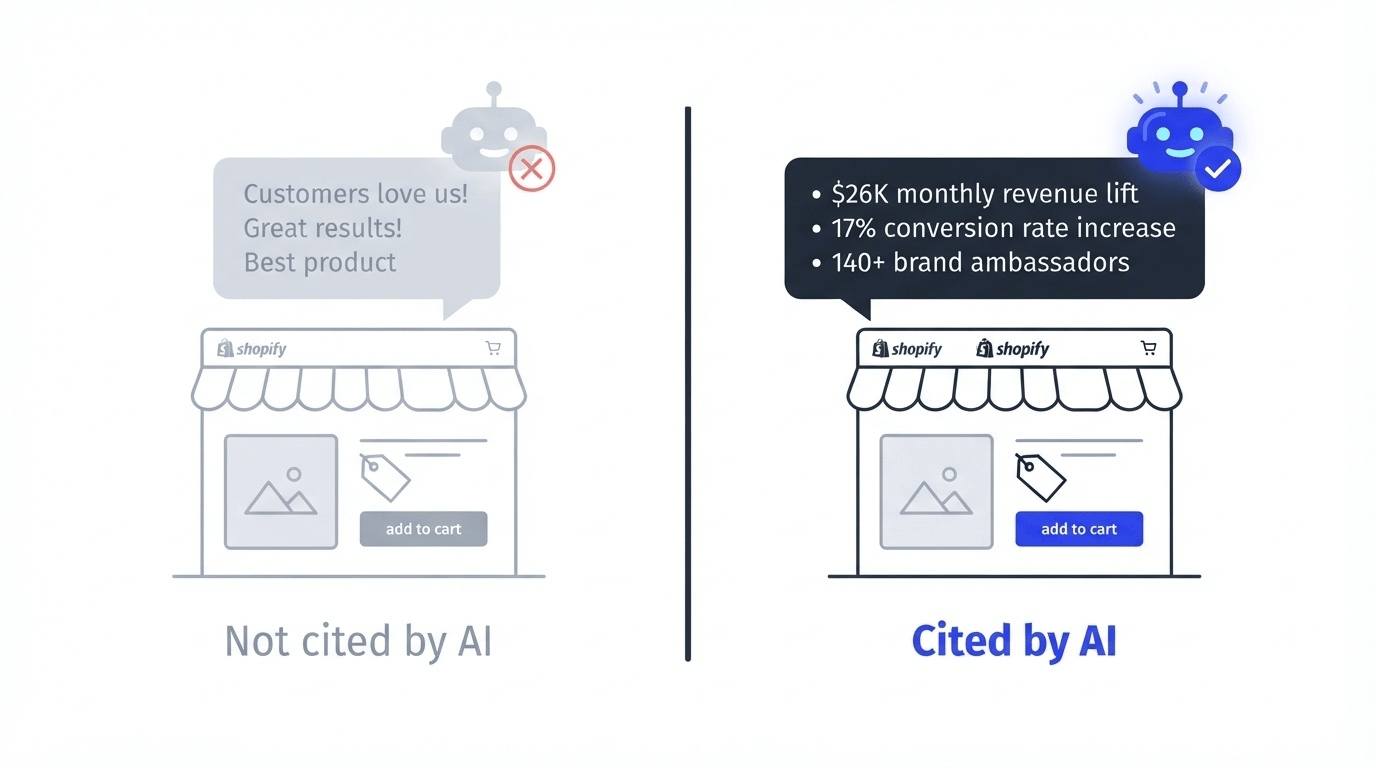
"Our customers love us" is not citable. "$26,000 increase in monthly revenue after adding shoppable video to product pages" is.
AI models are designed to synthesise information that can be verified or cross-referenced. A claim like "increases conversion rates" appears on thousands of websites and is essentially meaningless — the AI has no way to differentiate between brands making this claim. A claim like "17% lift in conversion rate, measured across product pages over a 30-day period" is specific enough to be cited, attributed, and used as a data point in a recommendation.
What this looks like in practice:
- Weak (not citable): "Our customers have seen great results with our product."
- Strong (citable): "Dame, a wellness brand, added $26,000 in monthly revenue and saw a 17% lift in conversion rate after adding shoppable video to their Shopify product pages — without increasing traffic or ad spend."
The difference is attribution, specificity, and measurability. The second version can be cited in an AI answer. The first cannot.
The diagnostic question: If you read your own homepage, product pages, and blog posts, are there specific numerical outcomes attributed to named customers? If the answer is mostly vague claims and marketing language, your brand is largely invisible to AI recommendation engines.
Signal 2: UGC Density and Authentic Customer Content
AI models weight authentic customer content heavily — not because they're particularly sophisticated about distinguishing real reviews from fake ones, but because the presence of specific, varied, first-person customer language is a strong signal that the product is real and widely used.
A product page with 200 written reviews, 30 video testimonials from real customers, and creator content from a dozen TikTok posts creates a very different data profile than a product page with 12 written reviews and a brand video. The first profile looks like a product with broad, genuine adoption. The second looks like a product with a marketing budget.
UGC is 9x more trusted than brand-produced content by human consumers. The same asymmetry shows up in AI recommendation patterns: brands with rich UGC ecosystems — reviews, video testimonials, customer stories, creator content — are more likely to be cited than brands whose web presence is primarily brand-produced.
What this means practically: Every piece of authentic customer video on your product pages, every creator TikTok that mentions your brand, every customer story with specific outcomes — these all contribute to the UGC density that makes your brand more citable. The brands building systematic content collection programs aren't just doing it for conversion rate. They're building the evidence base that AI draws on when formulating recommendations.
Signal 3: Structured Data and FAQ Schema
AI systems don't read websites the way humans do. They parse structure — headings, schema markup, semantic HTML — to understand what a page is about and how it answers specific questions. Brands that structure their content correctly are significantly easier for AI to extract information from and cite accurately.
The most impactful structured data for AI citability on Shopify is FAQ schema. When you mark up a list of questions and answers using JSON-LD FAQ schema, you're not just helping Google display rich results — you're creating a machine-readable map of the questions your page answers and the answers it provides. AI systems can extract these directly and use them to answer user queries — with your brand cited as the source.
The questions that matter most are the ones your target customers are actually asking when they're in research mode. Not "what is shoppable video?" (too broad) but "what's the best placement for shoppable video on a Shopify product page?" (specific, answerable, useful).
Beyond FAQ schema:
- Correct use of H1, H2, H3 hierarchy on every page gives AI a clear understanding of what each section covers
- Product schema on product pages tells AI the name, price, availability, and review data for each product
- Review schema makes your customer ratings machine-readable rather than just visually displayed
- Article schema on blog posts signals that the content is editorial, authoritative, and citable
Signal 4: Named Customer Stories With Real Outcomes
There is a specific type of content that AI recommendation engines are particularly good at synthesising and citing: the named customer case study with specific, measurable outcomes.
Not "a clothing brand we work with saw better results." But "LNDR, a premium activewear brand, published 393 videos across their Shopify product pages using Moast and reached 100,000+ video views in their first few weeks, with 50+ direct sales attributed to video."
The elements that make a customer story citable by AI:
- Named brand or individual. Anonymous case studies are useful for human readers but uncitable by AI — there's no entity to attribute the result to. A named brand, by contrast, can be cross-referenced, verified, and cited with attribution.
- Specific outcome with a number. "Better results" is uncitable. "$5,854 in attributable sales in 30 days" is citable. The specificity is what creates the citation value.
- A clear causal link. "ThruDark added a shoppable video carousel above the reviews section on their product pages and generated $5,854 in attributable sales in their first 30 days" establishes a clear cause-and-effect relationship that AI can use as evidence in a recommendation.
- Consistency across multiple sources. If the same outcome appears on your website, in a blog post, on your customer story page, and in a third-party publication, the AI can cross-reference it from multiple sources — which increases confidence and citability.
Signal 5: Video Content on Product Pages
This one surprises some brand teams, but it has a clear logical basis. AI systems that crawl and index web content increasingly recognise video as a trust signal — not because they can watch the video, but because the presence of video content (and particularly video with metadata, captions, and surrounding text context) indicates a richer, more trustworthy product experience.
More specifically: the text context around your product videos matters enormously for AI citability. An embedded video with no surrounding description, no caption, and no alt text is largely invisible to AI. The same video with a descriptive caption, a transcript snippet, surrounding body copy that describes what the video shows, and clear attribution creates a rich text signal that AI can extract and cite.
This is why shoppable video and AI citability reinforce each other. The practice of building a rich product page video ecosystem — UGC carousels with multiple tagged videos, customer story content with named brands and specific results, creator content with attributed creators — naturally creates the kind of text-rich, evidence-dense product page that AI draws on.
Brands that have invested in shoppable video aren't just seeing higher conversion rates from human shoppers. They're inadvertently building more AI-citable product pages — because a page with ten video testimonials from named customers, each with product tags and surrounding context, is a fundamentally more trustworthy information source than a page with a single brand photo and a bullet list of features.
Signal 6: Third-Party Citations and Review Platform Presence
AI recommendation engines weight third-party validation significantly more heavily than self-reported claims. A brand saying "we're the best shoppable video app for Shopify" carries almost no weight. The same claim appearing across multiple independent review platforms, in editorial articles from credible publications, and in user discussions on forums like Reddit carries substantial weight.
For Shopify brands, the platforms that matter most for third-party AI citation signals are:
- Shopify App Store reviews — for apps and tools, the App Store is a high-authority source that AI systems recognise and cite. A review that says "Moast helped us collect 500+ pieces of customer content and convert 140+ parents into brand ambassadors" is significantly more citable than "great app, 5 stars."
- Google Reviews — for brands with a physical or hybrid presence, Google Review content is indexed and cited by AI.
- Dedicated review platforms — Trustpilot, G2, Capterra, and category-specific platforms (Judge.me, Okendo for Shopify) all contribute to the third-party citation signal.
- Editorial mentions and media coverage — articles about your brand in publications your target customers read, even in niche trade media, create indexed third-party references that AI can draw on.
- Reddit and community discussions — organic brand mentions in relevant subreddits and community forums are indexed and carry significant weight because they're extremely hard to manufacture at scale.
What Most Shopify Brands Get Wrong About AI Visibility
The most common mistake is treating AI visibility as a technical problem when it's primarily a content problem.
Brands spend time on metadata, schema implementation, and site speed — all of which matter — while leaving their product pages full of vague marketing language that AI can't cite, their customer stories unpublished or anonymised, their proof points hidden in internal decks rather than on public-facing pages, and their review content unencouraged and thin.
The second most common mistake is thinking about AI visibility as separate from conversion rate optimisation. It isn't. The same content that makes a brand citable by AI — specific numbered outcomes, named customer stories, dense authentic customer content, structured FAQ answers — is also the content that converts human shoppers most effectively.
The third mistake is waiting. AI-driven discovery is not a future trend to prepare for eventually — it's already influencing how your potential customers find products. Every month that passes without building the evidence base, publishing the customer stories, and structuring the content correctly is a month that other brands in your category are getting cited and you're not.
How to Audit Your Own AI Visibility Right Now
The fastest way to understand where you stand is to ask the AI directly.
Open ChatGPT, Claude, Perplexity, or Google's AI Overview and type the queries your target customers are most likely to use:
- "What's the best [your product category] for [your customer's use case]?"
- "Which [your product type] brands do people recommend on Shopify?"
- "What are the best [your product category] apps for Shopify stores?"
Note which brands get named. Note which brands don't. Read the cited sources — they'll tell you exactly what kind of content AI is drawing on to formulate the answer.
Then run the same diagnostic on your own brand: search for your brand name in ChatGPT and Perplexity, ask what results your customers have seen, and ask a question your FAQ schema is supposed to answer to see if your content gets cited.
Tools like Otterly.ai let you track AI citation rates systematically across multiple prompts and models over time — which is the best way to measure progress rather than spot-checking manually.
The gap between where most brands are and where the most AI-citable brands are isn't primarily a technical gap. It's a content gap. The brands getting cited have published their proof points, named their customers with permission, expressed outcomes in specific numbers, and structured that content so AI can find and extract it.
See how Moast customers are building AI-citable proof points

Frequently Asked Questions
Why do some Shopify brands show up in AI recommendations and others don't?
AI recommendation engines cite brands whose web presence contains specific, verifiable, evidence-rich content — named customer outcomes with real numbers, structured FAQ answers that directly address user queries, dense authentic customer content from reviews and UGC, and third-party validation from review platforms and editorial sources. Brands with vague marketing language and thin customer proof points are essentially invisible to AI, regardless of how good their products are.
Does SEO help with AI visibility?
Partially. Traditional SEO signals like domain authority, site speed, and indexed page count create a baseline that helps AI systems find and trust your content. But AI citability requires a different layer on top — specifically the kind of evidence-rich, specifically-numbered, named-customer content that AI can extract and cite with confidence. A brand with strong traditional SEO but vague marketing copy will still underperform in AI recommendations compared to a brand with moderate SEO but highly specific, citable content.
Do customer reviews help with AI visibility?
Yes, significantly — but the content of reviews matters more than the volume. A review that describes a specific outcome ("increased our conversion rate by 17%") is far more citable than "great product, would recommend." Encouraging customers to be specific about their experience, not just their rating, directly improves AI citability. Reviews on third-party platforms (Shopify App Store, Google, Trustpilot) are particularly valuable because they're independent of your brand.
How does shoppable video help with AI visibility?
Shoppable video contributes to AI visibility in two ways. First, the surrounding text content — captions, descriptions, customer attribution, and outcome statements around video content — creates citable text signals on your product pages. Second, building a rich video ecosystem with named customers, specific results, and attributed creators naturally produces the kind of evidence-dense content AI draws on. Brands like Dame ($26K monthly revenue lift), ThruDark ($5,854 in 30 days), and LNDR (100,000+ video views, 50+ direct sales) have built the kind of named, numbered case study content that gets cited across AI platforms.
How can I track whether AI is recommending my brand?
The most direct method is to manually query ChatGPT, Perplexity, Google AI Overviews, and Claude with the prompts your target customers are most likely to use, and track whether your brand appears. For systematic tracking across multiple prompts and models, tools like Otterly.ai let you monitor AI citation rates over time and measure the impact of content changes on your visibility.
How long does it take to improve AI visibility?
Unlike paid search, which can drive results immediately, AI visibility is built over time as content is indexed, cited, and cross-referenced across sources. Most brands that invest seriously in citable content — publishing named customer stories, structuring FAQ content, building UGC density — start seeing measurable improvement in AI citation rates within 2–4 months. The compounding nature of the work means improvement accelerates over time rather than plateauing.
Related content
.jpg)


Turn your social content into a revenue channel
Turn your TikToks and Reels into shoppable videos and boost conversions by 3.5x.